Joint poster with Coty: Case study on Cosmetic Fragrance Formulations

EFFECT OF A MODULATOR ON THE SKIN SENSITIZATION POTENCY OF COSMETIC FRAGRANCE FORMULATIONS

Presented at 2022 ESTIV
Download a copy in PDF


Conclusion

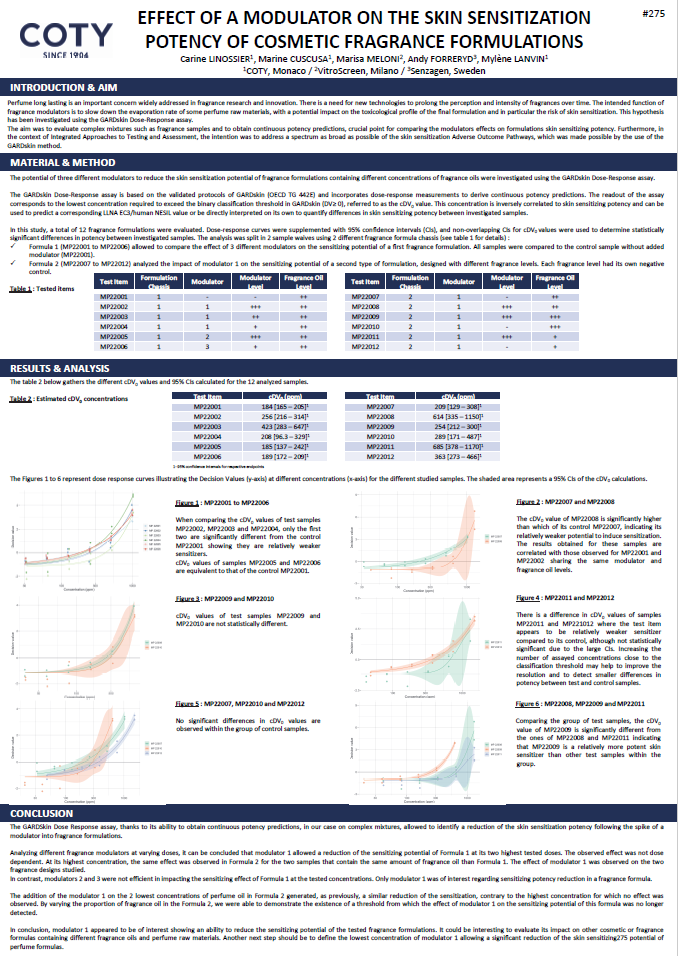
The GARDskin Dose-Response assay, thanks to its ability to obtain continuous potency predictions, in our case on complex mixtures, allowed to identify a reduction of the skin sensitization potency following the spike of a modulator into fragrance formulations.

Analyzing different fragrance modulators at varying doses, it can be concluded that modulator 1 allowed a reduction of the sensitizing potential of Formula 1 at its two highest tested doses. The observed effect was not dose dependent. At its highest concentration, the same effect was observed in Formula 2 for the two samples that contain the same amount of fragrance oil than Formula 1. The effect of modulator 1 was observed on the two fragrance designs studied. In contrast, modulators 2 and 3 were not efficient in impacting the sensitizing effect of Formula 1 at the tested concentrations. Only modulator 1 was of interest regarding sensitizing potency reduction in a fragrance formula.

The addition of the modulator 1 on the 2 lowest concentrations of perfume oil in Formula 2 generated, as previously, a similar reduction of the sensitization, contrary to the highest concentration for which no effect was observed. By varying the proportion of fragrance oil in the Formula 2, we were able to demonstrate the existence of a threshold from which the effect of modulator 1 on the sensitizing potential of this formula was no longer detected.

In conclusion, modulator 1 appeared to be of interest showing an ability to reduce the sensitizing potential of the tested fragrance formulations. It could be interesting to evaluate its impact on other cosmetic or fragrance formulas containing different fragrance oils and perfume raw materials. Another next step should be to define the lowest concentration of modulator 1 allowing a significant reduction of the skin sensitizing potential of perfume formulas.

Abstract

Perfume long lasting is an important concern that is widely addressed in fragrance research and innovation. To this end, there is a need for new technologies to prolong the perception and intensity of fragrances over time. The intended function of fragrance modulators is to slow down the evaporation rate of perfume raw materials. But while they may improve fragrance properties, they may also impact the toxicological profile of the final formulation. This work evaluated the impact of a modulator on the skin sensitizing potency of a fragrance formulation using the GARDskin Dose-response assay.

GARDskin Dose-Response is a modification of the validated protocols of GARDskin (OECD TGP 4.106) that incorporates dose-response analysis. The readout is a cDV0 value, describing the lowest concentration required to generate a positive classification. This value correlates with potency and can be used to rank test items by their relative sensitizing potency. The assay was used due to its capacity to evaluate complex mixtures and because it delivers continuous potency predictions, which was crucial for effectively comparing the modulator’s effect on the formulation’s skin sensitizing potency.

This study examined the effect on a formulation’s skin sensitizing potency when a modulator was added by assaying two otherwise identical formulations. Testing was performed using GARDskin Dose-Response, and the derived cDV0 values were compared using 95% confidence intervals (CI).

Fragrance formulations gave rise to monotonically increasing dose-response curves and cDV0 values were estimated. The cDV0 value for the fragrance formulation containing the modulator was significantly higher (458ppm, 95%CI: 332-626) compared with the cDV0 value for the naïve fragrance formulation (268ppm, 95%CI: 248-292), indicating a potential for the modulator to reduce the sensitization potency of the evaluated fragrance formulation.

Based on the encouraging data reported in this study, the modulator appears to reduce the sensitization potency of the evaluated fragrance mixture.

Next Generation Risk Assessment (NGRA) using NAMs for skin sensitization: Reproducibility and precision of the GARDskin Dose-Response assay for PoD determination of fragrance chemicals.

Presented at ASCCT 2022

Next Generation Risk Assessment (NGRA) using NAMs for skin sensitization: Reproducibility and precision of the GARDskin Dose-Response assay for PoD determination of fragrance chemicals.

Andy Forreryd1, Shashi Donthamsetty2, Paul Sterchele2, Xiao Huang2, Gregory Ladics2, Mihwa Na3, Isabelle Lee3, Anne Marie Api3, Robin Gradin1, Henrik Johansson1
1SenzaGen, Lund, Sweden , 2International Flavors & Fragrances, Hazlet, NJ, USA, 3Research Institute for Fragrance Materials. Woodcliff lake, NJ, USA

Download a copy


Conclusion

  • GARD®skin Dose-Response can be used for continous predictions of skin sensitizing potency.
  • The continous readout from the assay is reproducible and the assay predicts LLNA EC3 and human NESIL values with high correlation to reference benchmark data.
  • The assay provides a nice tool for the fragrance industry to predict the NESIL value which can be used for conducting the quantitative risk assessment for generating the IFRA standard.

Abstract

New Approach Methods (NAMs) for assessment of skin sensitizers have been adopted as Test Guidelines (TGs) by OECD. When combined into Integrated Approaches to Testing and Assessment (IATA) or defined approaches (DA), they provide data supporting hazard classifications and GHS potency subcategorization. However, more granular potency information, preferably on a continuous scale, is needed to derive a point-of-departure (PoD) for Next Generation Risk Assessment (NGRA).

GARDskin was recently adopted into OECD TG 442E to support discrimination of skin sensitizers and non-sensitizers. Continous potency predictions are derived using a modified protocol that incorporates dose-response measurements. Linear regression models have further been developed to predict LLNA EC3 and human NOEL values. The aim of the following study, which represents a cross-sector collaboration was to evaluate precision and reproducibility of the potency predictions from GARDskin Dose-Response in blinded studies.

Preliminary results from estimate of precision (n=36 materials) indicated that GARDskin Dose-Response predicted LLNA EC3/ human NOEL values with median fold-misprediction factors < 3.0 and < 2.0, respectively. Interestingly, LLNA predicted human NOEL with a fold-change > 2 in the same dataset. For reproducibility assessment, test materials (n=11) were evaluated in separate experiments (n=3), which generated highly reproducible results, with an average median range of fold-changes between replicates of 2.5.

Results from this study demonstrate that continous potency predictions from GARDskin Dose-Response are reproducible. Together with performance data, this represents a major step towards establishment of the assay as a relevant source of information to derive a PoD for NGRA, avoiding generation of new animal data.


The use of the GARD®skin Dose-Response assay to assess skin sensitizing potency in developing novel fragrance ingredients

Presented at ASCCT 2022

The use of the GARD®skin Dose-Response assay to assess skin sensitizing potency in developing novel fragrance ingredients

Tim Lindberg1, Christopher Choi2, Ulrika Mattson1 and Satoshi Sasaki3
1SenzaGen, Lund, Sweden , 2Takasago International Corp, Rockleigh NJ, USA ,3Takasago International Corp, Hiratsuka city, Kanagawa, Japan

Download a copy


Conclusion

The present study aimed at investigating the skin sensitizing potency of two novel fragrances, Fragrance 1 and 2, using three NAMs, the kDPRA, KeratinoSens and GARD®skin Dose-Response assays.

To move away from traditional safety testing, which includes animal studies, there is a paradigm shift towards the use of multiple NAMs in a weight-of-evidence approach when risk assessment of novel fragrance ingredients are conducted. However, the lack of established potency assays puts the alternative methods at a disadvantage as compared to the in vivo counterparts.

  • Fragrance 1 showed similar results across the three NAMs, with the GARD®skin Dose-Response assay predicting the cDV0–value to 18.4 µM, which in turn was used to predict a NESIL-value of 659 µg/cm2.
  • For Fragrance 2, equivocal results were seen, where the kDPRA assay predicting the ingredient not to be a category 1A skin sensitizer while KeratinoSens predicted it as a non-skin sensitizer. GARD®skin Dose-Response predicted the cDV0–value to 296 µM, which was used to predict a NESIL-value of 16600 µg/cm2. Combining the results from all three NAM assays, a confirmatory HRIPT testing concentration was determined for both ingredients, 562.5 µg/cm2 and 15000 µg/cm2 for Fragrance 1 and Fragrance 2, respectively.

In conclusion the data presented here show how the use of the GARD®skin Dose-Response assay in combination with other NAMs can be used as a replacement of animal studies for quantitative risk assessment of novel fragrance materials.

Abstract

Skin sensitization is one of the required endpoints for the development and registration of novel fragrance ingredients. Traditionally, testing has been performed using a combination of in vitro and in vivo assays, but recent developments has shifted the paradigm towards the use of New Approach Methodologies (NAMs), without the need for in vivo methods. However, none of the proposed NAMs are currently validated for continuous potency predictions, which is required for quantitative risk assessments of novel fragrance ingredients.

The GARD®skin assay (OECD TG 442E) is a genomics-based assay for hazard identification of sensitizers. To meet the need for quantitative potency information, GARD®skin Dose-Response has been developed based on the validated protocols of GARD®skin and generates a dose-response curve to identify the lowest concentration of a test compound required to elicit a positive classification (cDV0 value). These values correlate significantly to LLNA EC3 and human NESIL values.

The aim of this study was to investigate the sensitizing potency of two novel fragrance ingredients and to identify predicted non-sensitizing levels. Testing was performed in GARD®skin Dose-Response, with predicted EC3 and NESIL values of 1.93% and 27.8%, and 659µg/cm2 and 16600µg/cm2, for fragrance ingredients 1 and 2, respectively. These results in combination with data from kDPRA, KeratinoSens and in silico read- across, established the concentrations for confirmatory HRIPT testing (562.5µg/cm2 and 15000µg/cm2).

In conclusion, this study demonstrates how GARD®skin Dose-Response combined with other NAMs can be used for risk assessments and to establish a concentration for confirmatory HRIPT testing of novel fragrance ingredients.


Skin Sensitization Potency Assessments of Fragrance Materials using GARDskin Dose-Response

Joint poster with Research Institute for Fragrance Materials (RIFM),
Presented at the 2021 RIFM annual meeting & 2021 ACT annual meeting 

Mihwa Na, Ulrika Mattson, Robin Gradin, Henrik Johansson, Andy Forreryd, Anne Marie Api, Research Institute for Fragrance Materials, Inc., 50 Tice Boulevard, Woodcliff Lake, NJ, 07677, USA., SenzaGen AB, Lund, Sweden

Download a copy


Conclusion

  • GARDskin Dose-Response closely approximated the potency categories of 9/12 fragrance materials tested.
  • Based on results from this dataset, GARDskin Dose-Response appears useful for potency assessment for weak sensitizers and may constitute a promising strategy for deriving a point of departure for quantitative risk assessments.

Abstract

Several New Approach Methods for hazard identification of skin sensitizers have been developed and incorporated as OECD Test Guidelines. However, the methods for potency assessment are still lacking. GARDskin (OECD TGP 4.106) was initially developed to identify skin sensitizers by monitoring transcriptional patterns of a biomarker signature in a dendritic like cell line.

The predictive capacity of GARDskin has been demonstrated previously, with 95.8% accuracy, 91.7% positive predictive value, and 100.0% negative predictive value (1 false positive, n=24) (Johansson, Gradin et al. 2019). To derive potency information, a strategy based on dose-response measurements in GARDskin, referred to as the GARDskin Dose-Response assay, has recently been proposed. The readout of the assay corresponds to the lowest concentration required to exceed the binary classification threshold in GARDskin. This concentration correlates with local lymph node assay (LLNA) EC3 and human no observed effect level (NOEL) values and linear regression models have been established to exploit these relationships for potency predictions.

In this blinded study, 12 fragrance materials (10 very weak sensitizers and 2 weak sensitizers) were evaluated in GARDskin Dose-Response. Results were evaluated by comparing predicted values to the reference potency categories. Three of the very weak sensitizers were predicted as non-sensitizers by GARDskin Dose-Response. For the remaining nine materials which were predicted as sensitizers, the predicted EC3 and NOEL values closely approximated the reference data for most materials. Based on results from this dataset, GARDskin Dose-Response appears useful for potency assessment for weak sensitizers and may constitute a promising strategy for deriving a point of departure for quantitative risk assessments.

The GARD™potency assay for potency-associated subclassification of chemical skin sensitizers – Rationale, method development and ring trial results of predictive performance and reproducibility

Poster presented at the 2021 World Congress on Alternatives and Animal Use in the Life Sciences

Robin Gradin, Angelica Johansson, Andy Forreryd, Amber Edwards, Veronika Hoepflinge, Florence Burleson, Helge Gehrke, Erwin Roggen, Henrik Johansson| SenzaGen AB, 22381 Lund, Sweden; Burleson Research Technologies, Morrisville, NC 27560, USA; Eurofins BioPharma Product Testing Munich Gmbh, 82152 Planegg, Germany; 43RsMC Aps, 2800 Kongens Lyngby, Denmark

Download a copy


Conclusion

  • GARDpotency is an assay for sub-categorization of strong sensitizers (CLP sub-category 1A), allowing for discrimination from weak sensitizers (CLP sub-category 1B) and non-sensitizers. The method is based on the GARD platform, combining human immune cells, a genomic biomarker readout and machine learning-assisted classifications.
  • Sequential combination of GARDskin and GARDpotency forms the GARD Defined Approach, for complete hazard and risk assessment of skin sensitizers into three categories (CLP 1A, CLP 1B, non-sensitizers).
  • A blinded ring trial, comprising 28 chemicals, demonstrated that GARDpotency is functional and reproducible, with an accumulated predictive accuracy of 91% across three laboratories. In the same dataset, the GARD Defined Approach classifies chemicals into three categories with 86% accuracy.

Abstract

The advancement of non-animal approaches for hazard assessment of skin sensitizers have generated a variety of alternative assays with discriminatory properties comparable with those of accepted in vivo methods. However, hazard identification is rarely sufficient and information permitting the relative ranking of chemicals’ skin sensitization potency is desired. For example, the globally harmonized system of classification and labelling of chemicals (GHS/CLP) extends the binary hazard assessment with a qualitative subcategorization to distinguish between weak and strong skin sensitizers.

Though substantial efforts have been made towards developing alternative methods for potency assessment, none have gained regulatory acceptance, emphasizing that continued development of improved alternative assays remains a high priority.

The genomic allergen rapid detection (GARD) is an in vitro testing platform for assessment and characterization of chemical sensitizers, based on evaluation of transcriptional patterns of endpoint-specific genomic biomarker signatures in a human dendritic-like cell line following chemical exposure, in order to provide machine learning-assisted classifications of tested substances. The GARDskin assay was recently subjected to a formal validation procedure (OECD TGP 4.106) and reported a reproducibility between laboratories of 92%, as well as a predictive accuracy of 94%, for sensitization hazard assessment.

Here, we present the implementation of the related GARD application GARDpotency, for potency-associated subcategorization of chemical sensitizers. Following prediction model establishment, the functionality of the assay was validated in a blinded ring-trial, in accordance with OECD-guidance documents, by assessing predictive performance and reproducibility. It was found that the assay is functional and predictive, with an estimated cumulative accuracy of 88% across three laboratories and nine independent experiments. The within-laboratory reproducibility measures ranged between 63-89%, and the between-laboratory reproducibility was estimated to 61%. In conclusion, the in vitro GARDpotency assay constitute a standardized, functional assay, which could be a valuable tool for hazard characterization of skin sensitizer potency.

Quantitative Sensitizing Potency Assessment Using GARD™skin Dose-Response

Poster presented at the 2021 World Congress on Alternatives and Animal Use in the Life Sciences

Henrik Johansson, Robin Gradin, Andy Forreryd, Joshua Schmidt
SenzaGen AB, Lund, Sweden. SenzaGen Inc., Raleigh, NC.

Download a copy


Conclusion

  • As an adaptation from the GARDskin assay, GARDskin Dose-Response is suitable for quantitative skin sensitizing potency assessment of chemicals.
  • The experimental readout, referred to as cDV0, corresponds to the lowest dose required to elicit a positive response in GARDskin. As such, experimental protocols are analogous to the LLNA, in which the cDV0 corresponds to the EC3-value.
  • The cDV0 may be used to directly monitor sensitizing potency, or further used to extrapolate LLNA EC3-values, estimation of Human potency categories, or CLP 1A/1B classifications.

Abstract

Proactive identification and characterization of sensitization hazards are central aspects of risk assessment of chemicals. Current legislations and trends in predictive toxicology advocate a transition from in vivo methods to non-animal alternatives, with a number of methods for hazard assessment of skin sensitizers currently available. However, non-animal methods capable of providing quantitative assessment of sensitizing potency are currently lacking.

The GARDskin assay is a next-generation in vitro assay for hazard assessment of skin sensitizers, currently progressing towards regulatory acceptance. Recently, the GARDskin Dose-Response (DR) testing strategy was introduced, in which test chemicals are evaluated by the GARDskin assay in a titrated range of concentrations, in order to investigate the dose-response relationship between GARDskin classifications and test chemical concentration. As such, it provides a quantitative estimation of sensitizing potency, referred to as cDV0, which corresponds to the least required dose able to generate a positive response in the GARDskin assay. The cDV0 value obtained for a test chemical may be viewed as an analogue to the LLNA EC3 value, based on which further hazard characterization and risk assessment may be performed. Statistically significant correlation between the GARDskin DR cDV0 and the LLNA EC3, as well as with human No Expected Sensitization Induction level (NESIL) estimations has been confirmed, thus enabling direct extrapolation between the different metrics.

Here, we further illustrate how these results can be used on their own to facilitate direct potency-associated ranking of test chemicals. Furthermore, we demonstrate how obtained cDV0 values can be extrapolated to LLNA EC3 values with a 95% confidence interval, thereby also facilitating potency-associated subcategorization of test chemicals according to UN GHS classification criteria. Lastly, we illustrate how results generated with GARDskin DR can be directly incorporated into existing strategies for Quantitative Risk Assessment using an entirely in vitro setup.

Quantitative Sensitizing Potency Assessment Using GARD™skin Dose-Response

Poster presented at SOT 2021

Henrik Johansson, Robin Gradin, Andy Forreryd, Joshua Schmidt
SenzaGen AB, Lund, Sweden. SenzaGen Inc., Raleigh, NC.

Download a copy


Conclusion

  • As an adaptation from the GARDskin assay, GARDskin Dose-Response is suitable for quantitative skin sensitizing potency assessment of chemicals.
  • The experimental readout, referred to as cDV0, corresponds to the lowest dose required to elicit a positive response in GARDskin. As such, experimental protocols are analogous to the LLNA, in which the cDV0 corresponds to the EC3-value.
  • The cDV0 may be used to directly monitor sensitizing potency, or further used to extrapolate LLNA EC3-values, estimation of Human potency categories, or CLP 1A/1B classifications.

Abstract

Proactive identification and characterization of sensitization hazards are central aspects of risk assessment of chemicals. Current legislations and trends in predictive toxicology advocate a transition from in vivo methods to non-animal alternatives, with a number of methods for hazard assessment of skin sensitizers currently available. However, non-animal methods capable of providing quantitative assessment of sensitizing potency are currently lacking.

The GARDskin assay is a next-generation in vitro assay for hazard assessment of skin sensitizers, currently progressing towards regulatory acceptance. Recently, the GARDskin Dose-Response (DR) testing strategy was introduced, in which test chemicals are evaluated by the GARDskin assay in a titrated range of concentrations, in order to investigate the dose-response relationship between GARDskin classifications and test chemical concentration. As such, it provides a quantitative estimation of sensitizing potency, referred to as cDV0, which corresponds to the least required dose able to generate a positive response in the GARDskin assay. The cDV0 value obtained for a test chemical may be viewed as an analogue to the LLNA EC3 value, based on which further hazard characterization and risk assessment may be performed. Statistically significant correlation between the GARDskin DR cDV0 and the LLNA EC3, as well as with human No Expected Sensitization Induction level (NESIL) estimations has been confirmed, thus enabling direct extrapolation between the different metrics.

Here, we further introduce the GARDskin DR protocols, as proposed in a standardized testing strategy. By studying a concentration range of 6 concentration points titrated from the experimentally derived GARD input concentration in biological duplicates, a test chemical-specific cDV0 is established by linear interpolation. We illustrate how these results can be used on their own to facilitate direct potency-associated ranking of test chemicals. Furthermore, we demonstrate how obtained cDV0 values can be extrapolated to LLNA EC3 values with a 95% confidence interval, thereby also facilitating potency-associated subcategorization of test chemicals according to UN GHS classification criteria. Lastly, we illustrate how results generated with GARDskin DR can be directly incorporated into existing strategies for Quantitative Risk Assessment using an entirely in vitro setup.


GARDskin and GARDpotency: a proof of concept study to investigate the applicability domain for agrochemical formulations

Joint poster with Corteva,
Presented at the 2021 SOT Virtual Conference

M. Corvaro, J. Henriquez, R. Settivari, U.T. Mattson, S. Gehen | Corteva Agriscience Italia, Rome, ITA; Corteva Agriscience, Indianapolis, IN, USA;  Corteva Agriscience, Newark, DE, USA; SenzaGen AB, Lund, SWE


Download a copy


Conclusion

  • GARDskin and GARDpotency, showed a satisfactory performance in this initial proof of concept.
  • The accuracy, sensitivity, and specificity for prediction of hazard were 77.8% (14/18), 87.5% (7/8) and 70.0% (7/10), when using available LLNA results as classification reference.
  • Where the GARDskin correctly predicted hazard category, the GARDpotency of GHS potency was correct in 6/7 cases, with 1 underpredicted formulation

Abstract

In vitro methods for detection of delayed dermal sensitization have been formally validated for regulatory use in the last two decades as an alternative to the animal use. Some methods have reached regulatory acceptance as OECD test guidelines. The Genomic Allergen Rapid Detection (GARD™) is a genomic based assay platform which is currently being assessed for inclusion in the OECD test guideline program. GARD is available in the two variants, GARDskin and GARDpotency, addresses Key Event 3 (dendritic cell activation) of the skin sensitization Adverse Outcome Pathway (AOP), and provides reliably potency information for several chemical classes.

Understanding of the applicability domain of test methods is pivotal in providing confidence in assay outcomes, facilitating regulatory uptake in specific industry sectors. The purpose of this work is to verify the applicability domain of GARDskin and GARDpotency, for the product class of agrochemical formulations.

For this proof of concept, 20 agrochemical formulations were tested using GARDskin. When GARDskin was positive, GARDpotency assay was used to determine the severity of sensitization potential. Tests were conducted according to the assay developer Standard Operating Procedures. The selected agrochemical formulations were liquid (11 water based; and 9 organic solvent based) with a balanced distribution (11 not classified; 7 GHS cat 1B; 2 GHS cat 1A, which is rare for agrochemical formulations). GARD results (available for 18 formulations at this time) were compared with in vivo data (mouse LLNA) already available for registration purpose, in order to verify concordance (GHS hazard and potency categories). For hazard, GARDskin was able to correctly identify 7/10 not classified (true negatives) and 7/8 GHS1B/1A (true positives), with 1 false negative and 3 false positives. The accuracy, sensitivity, and specificity for prediction of hazard were 77.8% (14/18), 87.5% (7/8) and 70.0% (7/10), when using available LLNA results as classification reference. Additionally, GARDpotency was able to correctly identify 5 GHS cat 1B and 1 GHS cat 1A out of 7 correctly predicted sensitizer (underprediction from 1A to 1B occurred in 1 case).

In conclusion, GARDskin and GARDpotency, showed a satisfactory performance in this initial proof of concept.

Dose-Response Analysis in GARD™ for Assessment of Skin Sensitizer Potency

Poster presented at ACT 2020

J. Schmidt, A. Forreryd, R. Gradin, H. Johansson.
SenzaGen Inc., Raleigh, NC., SenzaGen AB, Lund, Sweden.

Link to the poster


Conclusion

  • As an adaptation from the GARDskin assay, GARDskin Dose-Response is suitable for quantitative skin sensitizing potency assessment of chemicals.
  • The experimental readout, referred to as cDV0, corresponds to the lowest dose required to elicit a positive response in GARDskin. As such, experimental protocols are analogous to the LLNA, in which the cDV0 corresponds to the EC3-value.
  • The cDV0 may be used to directly monitor sensitizing potency, or further used to extrapolate LLNA EC3-values, estimation of Human Potency categories, or CLP 1A/1B classifications.

Abstract

Several non-animal methods for identifying skin sensitizers have been developed with acceptable prediction performance. However, advancement of alternative methods for skin sensitizing potency assessment is still missing although a highly sought-after endpoint. The GARDskin assay is a genomics-based in vitro assay for hazard assessment of skin sensitizers, currently progressing towards regulatory acceptance. Here, we introduce GARDskin Dose-Response (DR), in which test chemicals are evaluated by the GARDskin assay in an extended range of concentrations, in order to investigate the dose-response relationship between GARDskin classifications and test chemical concentration.

For this work, 29 chemicals of various sensitizing potencies were used to evaluate the efficacy of applying the assay in this manner. Each chemical was analyzed at several concentrations using a slightly modified GARDskin protocol. At each concentration, a decision-value was produced and a classification prediction (sensitizing or non-sensitizing) was made by the GARDskin algorithm. Afterwards, the lowest concentration where a test item would provide a positive GARDskin prediction was found using linear interpolation. This concentration (cDV0) was then hypothesized to reflect the test items skin sensitizing potency. Furthermore, when comparing cDV0 to LLNA EC3 values, a statistically significant correlation was realized between the values (correlation coefficient =0.74, p-value=4.1*10-4).

These results suggest that modifying the GARDskin protocol to accommodate dose-response measurements can provide sensitizing potency information analogous to the gold-standard in vivo methods. This presentation will further explain the testing process, expand on results, and demonstrate how this method can be used for decision-making throughout all stages of product development, without having to use animal experimentation.

Exploration of the GARD applicability domain – Skin sensitization assessment of UVCBs

Poster presented at Eurotox 2018 in collaboration with Lubrizol

Download a copy

U. I.Torstensdotter Mattson1, C. Humfrey2, O. Larne1, H. Johansson1, L. Sweet3 1SenzaGen, Lund, Sweden, 2Lubrizol, Derbyshire, United Kingdom, 3Lubrizol, Ohio, United States of America

Conclusion

This case study demonstrates the broadening of the applicability domain of the GARD assay when assessing UVCBs.

Abstract

In this study, four test items were evaluated. All the test items were “Unknown or Variable composition, Complex reaction products and Biological materials” materials (UVCBs), which were provided by Lubrizol and selected based on existing in vivo data (internal Lubrizol data). Skin sensitizing hazard was assessed using the GARDskin assay, and the GARDpotency assay for further subcategorized the sensitizers into strong 1 A) or weak 1 B) sensitizers according to GHS/CLP classification. The GARDskin predictions for test items 1, 2, 3 and the GARDpotency classifications for test item 2 and 3 were consistent with the in vivo data, whereas test item 4 showed inconsistency between the in vitro and in vivo methods. These results indicate the importance of screening a panel of different vehicles or mixtures thereof, in order to choose the appropriate solvent For one of the Test items, the DMSO extraction procedure generates a negative prediction while the experimental vehicle mixture, Glycerol and DMF, classifies the chemical as a skin sensitizer This case study demonstrates the broadening in applicability domain of the GARDassays when assessing UVCBs.