Tag Archive for: Newsletter

SenzaGen’s Newsletter Q1 2026

Click image to view the Newsletter in browser.

 

Text version:

SenzaGen Newsletter Q1, 2026

SOT 2026: Advancing NAMs for skin and respiratory sensitization testing

We had a fantastic time at this year’s SOT meeting in San Diego, connecting with peers, exploring new ideas, and sharing the latest GARD® data on skin and respiratory sensitization from our industry collaborations. Thank you to all our collaborative partners for the outstanding teamwork!

Bayer | Coty | ExxonMobil | GDIT | Haleon | J&J MedTech | Merck

GARD for assessing biopesticides and complex mixtures

Dr Andy Forreryd and Dr Tim Lindberg of SenzaGen presented at SOT symposium sessions, demonstrating how GARD® supports sensitization assessment of biopesticides and complex mixtures.

Respiratory sensitization, protein allergy and medical devices

At SenzaGen’s hosted session, guest speakers from Merck, GDIT, and J&J MedTech shared new GARD® data on respiratory sensitization and ISO 10993-10 compliance for medical devices.

New scientific publication: Quantitative risk assessment of fragrance materials using NAMs

The collaborative work within the International Dialogue for the Evaluation of Allergens (IDEA) has been recently published in Regulatory Toxicology and Pharmacology, presenting new peer-reviewed evidence on the application of New Approach Methodologies (NAMs) in quantitative risk assessment (QRA) of fragrance materials.

The study demonstrates that SenzaGen’s single-assay method GARD®skin Dose-Response, alongside the multiple-assay approaches, delivers PoDs that well align with established human and animal reference potency data, within the expected biological variability.

Read the full article

Establishing safe dose levels for cosmetic ingredients

We are pleased to see another leading global cosmetics company adopt GARD®skin Dose-Response to assess safe use levels of ingredients with potential skin-sensitizing properties. Powered by genomics and machine learning, the assay can be used as a standalone method to support robust, science-driven product development.

Explore 3 typical use scenarios

Upcoming events

🌎 Conference: ITCASS and ERGECD meeting | Strasbourg, France | April 15-17
🎧 Webinar: Advancing NAMs for respiratory sensitization testing-SOT Recap | Apr 22
🌎 Conference: ESTIV Congress | Maastricht, the Netherlands | June 29-July 2

SenzaGen’s Newsletter Q4 2025

Click image to view the Newsletter in browser.


Text version:

SenzaGen Newsletter Q4, 2025

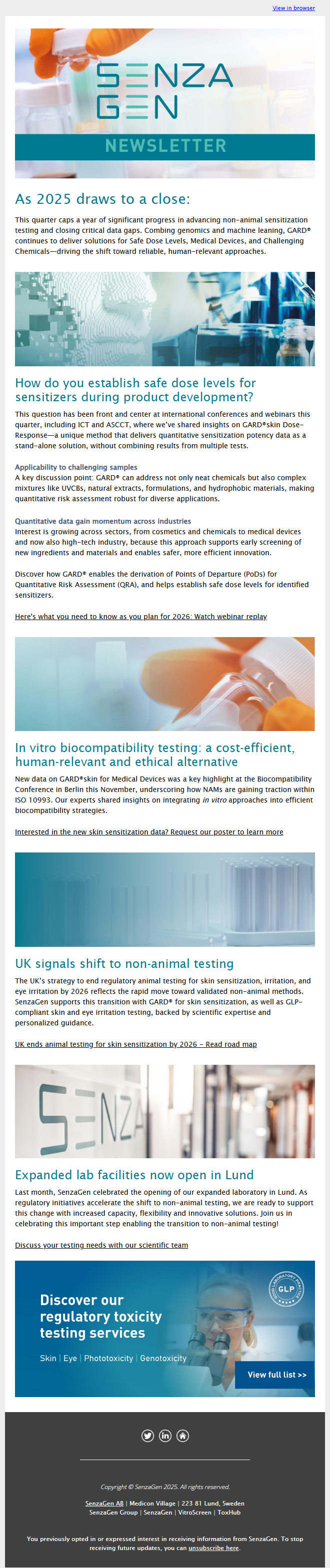
As 2025 draws to a close:

This quarter caps a year of significant progress in advancing non-animal sensitization testing and closing critical data gaps. Combing genomics and machine leaning, GARD® continues to deliver solutions for Safe Dose Levels, Medical Devices, and Challenging Chemicals—driving the shift toward reliable, human-relevant approaches.

2165 at a glance px webbbilder senzagen2

How do you establish safe dose levels for sensitizers during product development?

This question has been front and center at international conferences and webinars this quarter, including ICT and ASCCT, where we’ve shared insights on GARD®skin Dose-Response—a unique method that delivers quantitative sensitization potency data as a stand-alone solution, without combining results from multiple tests.

Applicability to challenging samples
A key discussion point: GARD® can address not only neat chemicals but also complex mixtures like UVCBs, natural extracts, formulations, and hydrophobic materials, making quantitative risk assessment robust for diverse applications.

Quantitative data gain momentum across industries 
Interest is growing across sectors, from cosmetics and chemicals to medical devices and now also high-tech industry, because this approach supports early screening of new ingredients and materials and enables safer, more efficient innovation.

Discover how GARD® enables the derivation of Points of Departure (PoDs) for Quantitative Risk Assessment (QRA), and helps establish safe dose levels for identified sensitizers.

Here’s what you need to know as you plan for 2026: Watch webinar replay

2129 Biocompatibility testing of medical devices

In vitro biocompatibility testing: a cost-efficient, human-relevant and ethical alternative

New data on GARD®skin for Medical Devices was a key highlight at the Biocompatibility Conference in Berlin this November, underscoring how NAMs are gaining traction within ISO 10993. Our experts shared insights on integrating in vitro approaches into efficient biocompatibility strategies.

Interested in the new skin sensitization data? Request our poster to learn more

2146 SenzaGen 2025 web sections

UK signals shift to non-animal testing

The UK’s strategy to end regulatory animal testing for skin sensitization, irritation, and eye irritation by 2026 reflects the rapid move toward validated non-animal methods. SenzaGen supports this transition with GARD® for skin sensitization, as well as GLP-compliant skin and eye irritation testing, backed by scientific expertise and personalized guidance.

UK ends animal testing for skin sensitization by 2026 – Read road map

2178 SenzaGen background

Expanded lab facilities now open in Lund

Last month, SenzaGen celebrated the opening of our expanded laboratory in Lund. As regulatory initiatives accelerate the shift to non-animal testing, we are ready to support this change with increased capacity, flexibility and innovative solutions. Join us in celebrating this important step enabling the transition to non-animal testing!

Discuss your testing needs with our scientific team

2171 LIME regulatory tox banner dec 2025 v3

SenzaGen’s Newsletter Q3 2025

Click image to view the Newsletter in browser.


Safe dose levels for sensitizers, NESIL values for HRIPT, and PoD-based QRA

Skin sensitization potency assessment has been in the spotlight at several toxicology conferences this summer, particularly for fragrances where defining safe dose levels, establishing NESIL values, and applying Point of Departure (PoD)-based Quantitative Risk Assessment (QRA) remain key challenges.

2142 GARD webinar

Webinar: In vitro skin sensitization potency assessment

Our on-demand webinar demonstrates how GARD®skin contributes to these needs with case studies on fragrances, essential oils, botanical extracts, and complex mixtures, in collaboration with Unilever, BIC, Takasago, dōTERRA, IFF, and RIFM.
WATCH THE RECORDING
2133 IHS 2 jpg

OECD TG 497 regulatory update at Eurotox

Thank you to everyone who visited us at this year’s Eurotox and joined the discussions on what GARD®skin’s inclusion in OECD TG 497 means for high performance and extended applicability within the DASS framework. We presented posters and led an interactive session demonstrating applications across complex substance categories such as UVCBs, natural extracts, hydrophobic materials, and formulations.

Connect with our specialists to discuss what this means for your regulatory testing strategy

2139 2132 Bilder A%cc%8aR2022.6

GARD® enters final ISO validation

– 100% reproducibility and 97% concordance

At the recent ISO TC 194/WG 8 meeting, SenzaGen presented pre-validation results for GARD®skin Medical Device. The assay achieved 100% reproducibility and 97% concordance with animal data, confirming it is robust and ready for the next step: interlaboratory ring trial validation. This milestone advances NAMs in ISO standards, supporting the shift to non-animal skin sensitization assessments.

Request the poster with full pre-validation data

Upcoming events

🌎 ICT 2025 | Beijing, China | Oct 15-18
🌎 ASCCT 2025 | Gaithersburg, USA | Oct 21-23
🌎 3rd Annual Medical Device Biocompatibility Conference | Berlin | Nov 6-7
🎧 Webinar: How GARDskin fits into OECD TG 497 | Nov 20

SenzaGen’s Newsletter Q2 2025

Click image to view the Newsletter in browser.

SenzaGen Newsletter 2025 Q2


SenzaGen Newsletter 2025 Q2

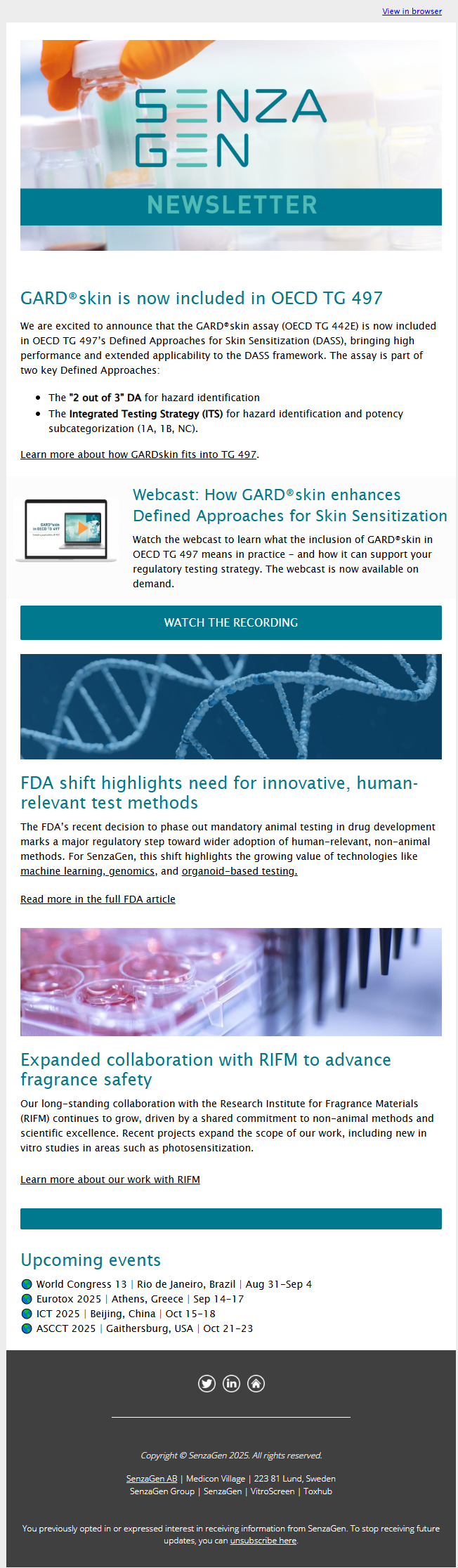
GARD®skin is now included in OECD TG 497

We are excited to announce that the GARDskin assay (OECD TG 442E) is now included in OECD TG 497’s Defined Approaches for Skin Sensitization (DASS), bringing high performance and extended applicability to the DASS framework. The assay is part of two key Defined Approaches:

  • The “2 out of 3” DA for hazard identification
  • The Integrated Testing Strategy (ITS) for hazard identification and potency subcategorization (1A, 1B, NC).

Learn more about how GARDskin fits into TG 497.

2066 ChatGPT Image 4 juli 2025 14 40 27
Webcast: How GARDskin enhances Defined Approaches for Skin Sensitization
Watch the webcast to learn what the inclusion of GARDskin in OECD TG 497 means in practice – and how it can support your regulatory testing strategy. The webcast is now available on demand.
WATCH THE RECORDING
2063 Genomics

FDA shift highlights need for innovative, human-relevant test methods

The FDA’s recent decision to phase out mandatory animal testing in drug development marks a major regulatory step toward wider adoption of human-relevant, non-animal methods. For SenzaGen, this shift highlights the growing value of technologies like machine learning, genomics, and organoid-based testing.

Read more in the full FDA article

1332 D R

Expanded collaboration with RIFM to advance fragrance safety

Our long-standing collaboration with the Research Institute for Fragrance Materials (RIFM) continues to grow, driven by a shared commitment to non-animal methods and scientific excellence. Recent projects expand the scope of our work, including new in vitro studies in areas such as photosensitization.

Learn more about our work with RIFM

Upcoming events

🌎 World Congress 13 | Rio de Janeiro, Brazil | Aug 31-Sep 4
🌎 Eurotox 2025 | Athens, Greece | Sep 14-17
🌎 ICT 2025 | Beijing, China | Oct 15-18
🌎 ASCCT 2025 | Gaithersburg, USA | Oct 21-23