The GARD™potency assay for potency-associated subclassification of chemical skin sensitizers – Rationale, method development and ring trial results of predictive performance and reproducibility

Poster presented at the 2021 World Congress on Alternatives and Animal Use in the Life Sciences

Robin Gradin, Angelica Johansson, Andy Forreryd, Amber Edwards, Veronika Hoepflinge, Florence Burleson, Helge Gehrke, Erwin Roggen, Henrik Johansson| SenzaGen AB, 22381 Lund, Sweden; Burleson Research Technologies, Morrisville, NC 27560, USA; Eurofins BioPharma Product Testing Munich Gmbh, 82152 Planegg, Germany; 43RsMC Aps, 2800 Kongens Lyngby, Denmark

Download a copy


Conclusion

  • GARDpotency is an assay for sub-categorization of strong sensitizers (CLP sub-category 1A), allowing for discrimination from weak sensitizers (CLP sub-category 1B) and non-sensitizers. The method is based on the GARD platform, combining human immune cells, a genomic biomarker readout and machine learning-assisted classifications.
  • Sequential combination of GARDskin and GARDpotency forms the GARD Defined Approach, for complete hazard and risk assessment of skin sensitizers into three categories (CLP 1A, CLP 1B, non-sensitizers).
  • A blinded ring trial, comprising 28 chemicals, demonstrated that GARDpotency is functional and reproducible, with an accumulated predictive accuracy of 91% across three laboratories. In the same dataset, the GARD Defined Approach classifies chemicals into three categories with 86% accuracy.

Abstract

The advancement of non-animal approaches for hazard assessment of skin sensitizers have generated a variety of alternative assays with discriminatory properties comparable with those of accepted in vivo methods. However, hazard identification is rarely sufficient and information permitting the relative ranking of chemicals’ skin sensitization potency is desired. For example, the globally harmonized system of classification and labelling of chemicals (GHS/CLP) extends the binary hazard assessment with a qualitative subcategorization to distinguish between weak and strong skin sensitizers.

Though substantial efforts have been made towards developing alternative methods for potency assessment, none have gained regulatory acceptance, emphasizing that continued development of improved alternative assays remains a high priority.

The genomic allergen rapid detection (GARD) is an in vitro testing platform for assessment and characterization of chemical sensitizers, based on evaluation of transcriptional patterns of endpoint-specific genomic biomarker signatures in a human dendritic-like cell line following chemical exposure, in order to provide machine learning-assisted classifications of tested substances. The GARDskin assay was recently subjected to a formal validation procedure (OECD TGP 4.106) and reported a reproducibility between laboratories of 92%, as well as a predictive accuracy of 94%, for sensitization hazard assessment.

Here, we present the implementation of the related GARD application GARDpotency, for potency-associated subcategorization of chemical sensitizers. Following prediction model establishment, the functionality of the assay was validated in a blinded ring-trial, in accordance with OECD-guidance documents, by assessing predictive performance and reproducibility. It was found that the assay is functional and predictive, with an estimated cumulative accuracy of 88% across three laboratories and nine independent experiments. The within-laboratory reproducibility measures ranged between 63-89%, and the between-laboratory reproducibility was estimated to 61%. In conclusion, the in vitro GARDpotency assay constitute a standardized, functional assay, which could be a valuable tool for hazard characterization of skin sensitizer potency.
Quantitative Sensitizing Potency Assessment Using GARD™skin Dose-Response

Poster presented at the 2021 World Congress on Alternatives and Animal Use in the Life Sciences

Henrik Johansson, Robin Gradin, Andy Forreryd, Joshua Schmidt
SenzaGen AB, Lund, Sweden. SenzaGen Inc., Raleigh, NC.

Download a copy


Conclusion

  • As an adaptation from the GARDskin assay, GARDskin Dose-Response is suitable for quantitative skin sensitizing potency assessment of chemicals.
  • The experimental readout, referred to as cDV0, corresponds to the lowest dose required to elicit a positive response in GARDskin. As such, experimental protocols are analogous to the LLNA, in which the cDV0 corresponds to the EC3-value.
  • The cDV0 may be used to directly monitor sensitizing potency, or further used to extrapolate LLNA EC3-values, estimation of Human potency categories, or CLP 1A/1B classifications.

Abstract

Proactive identification and characterization of sensitization hazards are central aspects of risk assessment of chemicals. Current legislations and trends in predictive toxicology advocate a transition from in vivo methods to non-animal alternatives, with a number of methods for hazard assessment of skin sensitizers currently available. However, non-animal methods capable of providing quantitative assessment of sensitizing potency are currently lacking.

The GARDskin assay is a next-generation in vitro assay for hazard assessment of skin sensitizers, currently progressing towards regulatory acceptance. Recently, the GARDskin Dose-Response (DR) testing strategy was introduced, in which test chemicals are evaluated by the GARDskin assay in a titrated range of concentrations, in order to investigate the dose-response relationship between GARDskin classifications and test chemical concentration. As such, it provides a quantitative estimation of sensitizing potency, referred to as cDV0, which corresponds to the least required dose able to generate a positive response in the GARDskin assay. The cDV0 value obtained for a test chemical may be viewed as an analogue to the LLNA EC3 value, based on which further hazard characterization and risk assessment may be performed. Statistically significant correlation between the GARDskin DR cDV0 and the LLNA EC3, as well as with human No Expected Sensitization Induction level (NESIL) estimations has been confirmed, thus enabling direct extrapolation between the different metrics.

Here, we further illustrate how these results can be used on their own to facilitate direct potency-associated ranking of test chemicals. Furthermore, we demonstrate how obtained cDV0 values can be extrapolated to LLNA EC3 values with a 95% confidence interval, thereby also facilitating potency-associated subcategorization of test chemicals according to UN GHS classification criteria. Lastly, we illustrate how results generated with GARDskin DR can be directly incorporated into existing strategies for Quantitative Risk Assessment using an entirely in vitro setup.

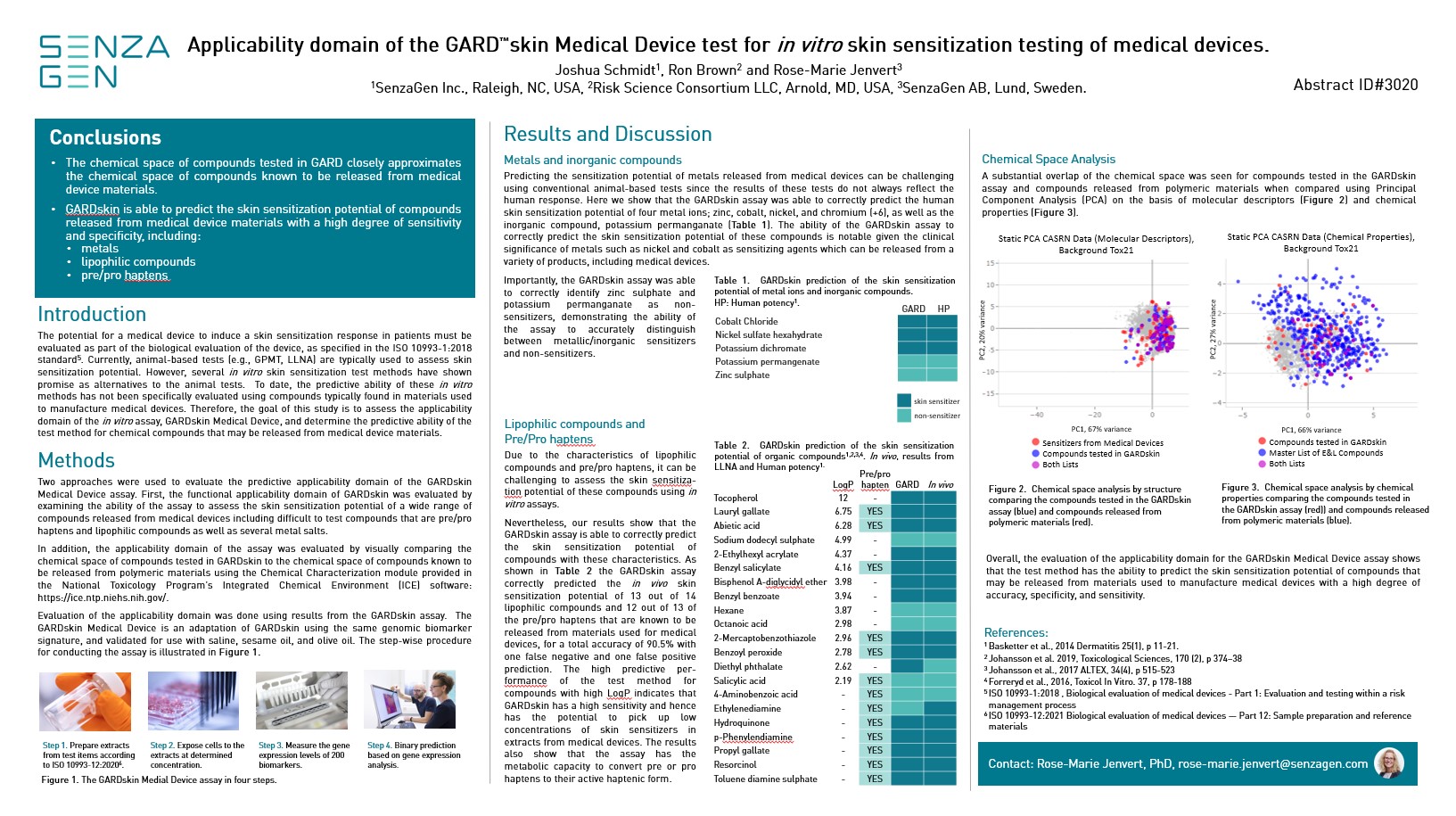
Applicability domain of the GARD™skin Medical Device test for in vitro skin sensitization testing of medical devices

Poster presented at SOT 2021

Joshua Schmidt, Ron Brown and Rose-Marie Jenvert
SenzaGen Inc., Raleigh, NC, USA, Risk Science Consortium LLC, Arnold, MD, USA, SenzaGen AB, Lund, Sweden.

Download a copy

Conclusion

  • The chemical space of compounds tested in GARD closely approximates the chemical space of compounds known to be released from medical device materials.
  • GARDskin is able to predict the skin sensitization potential of compounds released from medical device materials with a high degree of sensitivity and specificity, including: metals, lipophilic compounds and pre/pro haptens.

Abstract

Medical device toxicology is undergoing an exciting evolution; transitioning from a process that largely relied on the results of animal testing to evaluate the biological safety of devices in patients to one which is increasingly focused on the use of in vitro methods for the safety assessment of device materials.

Recently, in vitro methods to assess endpoints such as skin irritation and pyrogenicity have been validated and proposed for medical device testing, but a method to assess the potential for device-related skin sensitization to occur has not been sufficiently qualified. A number of in vitro skin sensitization test methods have been shown to have acceptable predictive ability for known skin sensitizers with structures that span a broad range of chemical classes, but the predictive ability of these methods has not been specifically evaluated using compounds typically found in materials used to manufacture medical devices. As a result, the need exists to qualify in vitro methods to assess the skin sensitization of compounds that may be released from medical devices, taking into account the applicability domain of known or potential skin sensitizers, including metals.

To address this challenge, the predictive ability of the GARD assay has been evaluated using a dataset of compounds known to be released from device materials.  Against these data, the assay correctly predicted 19 out of 21 lipophilic and pre-/pro-hapten compounds (90.5% accuracy), with one false positive (95.2% sensitivity) and one false negative (95.2% specificity) being predicted, thus increasing the confidence in use of this in vitro assay to assess the skin sensitization potential of medical devices.  Furthermore, we have also demonstrated that the GARD assay correctly predicts the skin sensitization response of nickel and cobalt salts (sensitizers) and a zinc salt (non-sensitizer). Overall, our data support the use of the GARDskin Medical Device assay as an in vitro alternative for the in vivo methods (e.g., GPMT, LLNA) that are typically used to assess skin sensitization as part of the biological safety assessment of medical devices.

Quantitative Sensitizing Potency Assessment Using GARD™skin Dose-Response

Poster presented at SOT 2021

Henrik Johansson, Robin Gradin, Andy Forreryd, Joshua Schmidt
SenzaGen AB, Lund, Sweden. SenzaGen Inc., Raleigh, NC.

Download a copy


Conclusion

  • As an adaptation from the GARDskin assay, GARDskin Dose-Response is suitable for quantitative skin sensitizing potency assessment of chemicals.
  • The experimental readout, referred to as cDV0, corresponds to the lowest dose required to elicit a positive response in GARDskin. As such, experimental protocols are analogous to the LLNA, in which the cDV0 corresponds to the EC3-value.
  • The cDV0 may be used to directly monitor sensitizing potency, or further used to extrapolate LLNA EC3-values, estimation of Human potency categories, or CLP 1A/1B classifications.

Abstract

Proactive identification and characterization of sensitization hazards are central aspects of risk assessment of chemicals. Current legislations and trends in predictive toxicology advocate a transition from in vivo methods to non-animal alternatives, with a number of methods for hazard assessment of skin sensitizers currently available. However, non-animal methods capable of providing quantitative assessment of sensitizing potency are currently lacking.

The GARDskin assay is a next-generation in vitro assay for hazard assessment of skin sensitizers, currently progressing towards regulatory acceptance. Recently, the GARDskin Dose-Response (DR) testing strategy was introduced, in which test chemicals are evaluated by the GARDskin assay in a titrated range of concentrations, in order to investigate the dose-response relationship between GARDskin classifications and test chemical concentration. As such, it provides a quantitative estimation of sensitizing potency, referred to as cDV0, which corresponds to the least required dose able to generate a positive response in the GARDskin assay. The cDV0 value obtained for a test chemical may be viewed as an analogue to the LLNA EC3 value, based on which further hazard characterization and risk assessment may be performed. Statistically significant correlation between the GARDskin DR cDV0 and the LLNA EC3, as well as with human No Expected Sensitization Induction level (NESIL) estimations has been confirmed, thus enabling direct extrapolation between the different metrics.

Here, we further introduce the GARDskin DR protocols, as proposed in a standardized testing strategy. By studying a concentration range of 6 concentration points titrated from the experimentally derived GARD input concentration in biological duplicates, a test chemical-specific cDV0 is established by linear interpolation. We illustrate how these results can be used on their own to facilitate direct potency-associated ranking of test chemicals. Furthermore, we demonstrate how obtained cDV0 values can be extrapolated to LLNA EC3 values with a 95% confidence interval, thereby also facilitating potency-associated subcategorization of test chemicals according to UN GHS classification criteria. Lastly, we illustrate how results generated with GARDskin DR can be directly incorporated into existing strategies for Quantitative Risk Assessment using an entirely in vitro setup.


GARDskin and GARDpotency: a proof of concept study to investigate the applicability domain for agrochemical formulations

Joint poster with Corteva,
Presented at the 2021 SOT Virtual Conference

M. Corvaro, J. Henriquez, R. Settivari, U.T. Mattson, S. Gehen | Corteva Agriscience Italia, Rome, ITA; Corteva Agriscience, Indianapolis, IN, USA;  Corteva Agriscience, Newark, DE, USA; SenzaGen AB, Lund, SWE


Download a copy


Conclusion

  • GARDskin and GARDpotency, showed a satisfactory performance in this initial proof of concept.
  • The accuracy, sensitivity, and specificity for prediction of hazard were 77.8% (14/18), 87.5% (7/8) and 70.0% (7/10), when using available LLNA results as classification reference.
  • Where the GARDskin correctly predicted hazard category, the GARDpotency of GHS potency was correct in 6/7 cases, with 1 underpredicted formulation

Abstract

In vitro methods for detection of delayed dermal sensitization have been formally validated for regulatory use in the last two decades as an alternative to the animal use. Some methods have reached regulatory acceptance as OECD test guidelines. The Genomic Allergen Rapid Detection (GARD™) is a genomic based assay platform which is currently being assessed for inclusion in the OECD test guideline program. GARD is available in the two variants, GARDskin and GARDpotency, addresses Key Event 3 (dendritic cell activation) of the skin sensitization Adverse Outcome Pathway (AOP), and provides reliably potency information for several chemical classes.

Understanding of the applicability domain of test methods is pivotal in providing confidence in assay outcomes, facilitating regulatory uptake in specific industry sectors. The purpose of this work is to verify the applicability domain of GARDskin and GARDpotency, for the product class of agrochemical formulations.

For this proof of concept, 20 agrochemical formulations were tested using GARDskin. When GARDskin was positive, GARDpotency assay was used to determine the severity of sensitization potential. Tests were conducted according to the assay developer Standard Operating Procedures. The selected agrochemical formulations were liquid (11 water based; and 9 organic solvent based) with a balanced distribution (11 not classified; 7 GHS cat 1B; 2 GHS cat 1A, which is rare for agrochemical formulations). GARD results (available for 18 formulations at this time) were compared with in vivo data (mouse LLNA) already available for registration purpose, in order to verify concordance (GHS hazard and potency categories). For hazard, GARDskin was able to correctly identify 7/10 not classified (true negatives) and 7/8 GHS1B/1A (true positives), with 1 false negative and 3 false positives. The accuracy, sensitivity, and specificity for prediction of hazard were 77.8% (14/18), 87.5% (7/8) and 70.0% (7/10), when using available LLNA results as classification reference. Additionally, GARDpotency was able to correctly identify 5 GHS cat 1B and 1 GHS cat 1A out of 7 correctly predicted sensitizer (underprediction from 1A to 1B occurred in 1 case).

In conclusion, GARDskin and GARDpotency, showed a satisfactory performance in this initial proof of concept.

Applicability of GARD™skin for Accurate Assessment of Challenging Substances in the Context of Skin Sensitization Testing

Poster presented at ACT 2020

J. Schmidt, A. Forreryd, H. Johansson, J. Li, A. Johansson
SenzaGen, Inc., Raleigh, NC, USA, SenzaGen AB, Lund, Sweden

Link to the poster


Conclusion

  • GARDskin demonstrated an overall high applicability for the evaluated challenging substances with 80% predictive accuracy compared to existing human data.
  • GARDskin demonstrated excellent applicability for pre/pro-haptens and low water solubility substances, correctly classifying all such compounds in the herein investigated dataset.
  • GARDskin also showed high applicability for assessment of surfactants with 89% predictive accuracy compared to existing human data, correctly classifying 8 out of 9 internally tested surfactants, including well known challenging ones such as Sodium Dodecyl Sulphate (SDS) and Benzalkonium chloride.

Abstract

Current legislations and trends in predictive toxicology advocate a transition from in vivo methods for hazard and risk assessments to non-animal alternatives. However, certain groups of chemicals, including substances with severe membrane-damaging properties, pre- and pro-haptens, and those with high log P ratios, have been shown to be challenging to assess using cell-based assays in the context of skin sensitization testing. The aim of this study was to evaluate the applicability of GARDskin for such challenging substances, using an overlapping subset of chemicals previously tested in an integrated tested strategy (ITS) based on validated, aqueous in vitro assays, as well as in a series of Reconstructed Human Epidermis (RHE)-based assays.

The GARDskin assay (Genomic Allergen Rapid Detection) is a robust in vitro assay for identification of potential chemical skin sensitizers with over 90% prediction accuracy and broad applicability. The assay is included in the OECD Test Guideline Program (OECD TGP 4.106) and has gone through a formal validation study. The assay evaluates the gene expression of endpoint-specific genomic biomarkers in a human dendritic-like cell line following exposure to the test substance. Exposure-induced gene expression patterns are analysed using pattern recognition and machine-learning technology, providing classifications of each test item as a skin sensitizer or a non-sensitizer.

The applicability of GARDskin for a total of twelve challenging substances, including pre- and pro-haptens, low water-soluble substances, two surfactants and three additional substances known to have conflictive results when comparing in vitro and in vivo data were evaluated in this study. All twelve substances were selected from the Mehling et al. 2019 publication which reported results from three OECD validated in vitro methods, the “2 out of 3” Integrated Testing Strategy, three RHE-based models and the murine local lymph node assay (LLNA). Human potency classification was available for ten out of the twelve substances.

The GARDskin prediction results were reported from previously published studies, or from in house validation studies. Predictive accuracies were calculated by comparing skin sensitization classifications from different test methods to the available human data of each substance respectively. (N=10). To further explore and substantiate the GARDskin applicability for surfactants, additional GARDskin data for a total of nine surfactants are presented in order to complement the Mehling dataset with respect to the availability of human data.

The GARDskin assay demonstrated overall high applicability for the evaluated challenging substances, with 80% predictive accuracy compared to existing human data. GARDskin correctly classified all pre-and pro-haptens and low water-soluble substances in the data set. Furthermore, high applicability of GARDskin for severe membrane disruptive substances such as surfactants was demonstrated, with 89% predictive accuracy compared to existing human data.


Dose-Response Analysis in GARD™ for Assessment of Skin Sensitizer Potency

Poster presented at ACT 2020

J. Schmidt, A. Forreryd, R. Gradin, H. Johansson.
SenzaGen Inc., Raleigh, NC., SenzaGen AB, Lund, Sweden.

Link to the poster


Conclusion

  • As an adaptation from the GARDskin assay, GARDskin Dose-Response is suitable for quantitative skin sensitizing potency assessment of chemicals.
  • The experimental readout, referred to as cDV0, corresponds to the lowest dose required to elicit a positive response in GARDskin. As such, experimental protocols are analogous to the LLNA, in which the cDV0 corresponds to the EC3-value.
  • The cDV0 may be used to directly monitor sensitizing potency, or further used to extrapolate LLNA EC3-values, estimation of Human Potency categories, or CLP 1A/1B classifications.

Abstract

Several non-animal methods for identifying skin sensitizers have been developed with acceptable prediction performance. However, advancement of alternative methods for skin sensitizing potency assessment is still missing although a highly sought-after endpoint. The GARDskin assay is a genomics-based in vitro assay for hazard assessment of skin sensitizers, currently progressing towards regulatory acceptance. Here, we introduce GARDskin Dose-Response (DR), in which test chemicals are evaluated by the GARDskin assay in an extended range of concentrations, in order to investigate the dose-response relationship between GARDskin classifications and test chemical concentration.

For this work, 29 chemicals of various sensitizing potencies were used to evaluate the efficacy of applying the assay in this manner. Each chemical was analyzed at several concentrations using a slightly modified GARDskin protocol. At each concentration, a decision-value was produced and a classification prediction (sensitizing or non-sensitizing) was made by the GARDskin algorithm. Afterwards, the lowest concentration where a test item would provide a positive GARDskin prediction was found using linear interpolation. This concentration (cDV0) was then hypothesized to reflect the test items skin sensitizing potency. Furthermore, when comparing cDV0 to LLNA EC3 values, a statistically significant correlation was realized between the values (correlation coefficient =0.74, p-value=4.1*10-4).

These results suggest that modifying the GARDskin protocol to accommodate dose-response measurements can provide sensitizing potency information analogous to the gold-standard in vivo methods. This presentation will further explain the testing process, expand on results, and demonstrate how this method can be used for decision-making throughout all stages of product development, without having to use animal experimentation.

Inter-laboratory ring trial of the GARD™air assay for assessment of respiratory sensitizers

Andy Forreryd1, Joshua Schmidt1, Robin Gradin1, Florence Burleson, Helge Gehrke3, Henrik Johansson1.
1SenzaGen AB, Lund, Sweden. 2Burleson Research Technologies, Morrisville, NC, USA. 3Eurofins BioPharma Product Testing Munich GmbH, Planegg, Germany.

Sensitization of the respiratory tract by sensitizing chemicals may lead to severe bronchoconstriction and asthma-like symptoms with a potentially fatal outcome. However, proactive identification and characterization of respiratory sensitization hazards is currently hampered by the lack of validated or even widely used predictive assays.

The GARD™ platform utilizes exposure-induced gene expression profiles of a dendritic cell-like cell line in combination with machine learning as a basis for predictive in vitro assays for different immunotoxicity endpoints (Johansson et al., 2020). Functional evidence of the ability to accurately identify respiratory sensitizers using the GARD platform has previously been demonstrated (Forreryd et al., 2015). Here, we present GARDair, an adaptation of previous findings on a gene expression analysis platform suited for routine acquisition, based on an optimized predictive biomarker signature. Furthermore, we present the initial results of an inter-laboratory ring-trial, demonstrating the functionality, transferability and reproducibility of the assay.

Conclusion

  • GARDair is a novel in vitro assay for assessment of respiratory sensitizers, based on evaluation of exposure-induced gene expression of genomic biomarkers in a Dendritic Cell-like cell and machine-learning assisted classification.
  • GARDair is the first in its class to be subjected to an inter-laboratory ring trial.
  • The method is highly specific, with high PPV, making it suitable for opt-out applications within product development and candidate prioritization.

Link to poster

Poster abstract accepted at SOT 2020. 

The GARD™Skin Assay: A New In Vitro Testing Strategy for Skin Sensitization

E. Schmidt, V. Zuckerstätter, H. Gehrke | Eurofins BioPharma Product Testing Munich GmbH

Introduction 
A skin sensitiser refers to a substance that will lead to an allergic response following skin contact as defined by the United Nations Globally Harmonized System of Classification and Labelling of Chemicals (UN GHS). The potential to induce skin sensitisation is an important consideration included in procedures for the safe handling, packaging and transports of chemicals.

The assessment of skin sensitisation typically involves the use of laboratory animals. Classical methods comprise the Magnusson Kligman Guinea Pig Maximisation Test, the Buehler Test (TG 406) as well as the local lymph node assay, in its radioactive and non-radioactive form (TG 429, TG 442A/B). In order to replace in vivo experiments validation studies on alternative, mechanistically based in chemico and in vitro test methods on skin sensitisation were conducted under the auspices of ECVAM and have been considered scientifically valid for the evaluation of the skin sensitisation hazard of chemicals.

Genomic Allergen Rapid Detection (GARDTM) is an in vitro assay designed to predict the ability of chemical substances to induce skin sensitisation based on the analysis of the relative expression levels of a biomarker signature of 196 genes using a human myeloid leukaemia cell line called SenzaCells. The GARDTM assay is based on chemical stimulation of the SenzaCells, acting as an in vitro model of human Dendritic Cells (DCs). The readout of the assay is a transcriptional quantification of the genomic predictors, collectively termed the GARDTM Prediction Signature (GPS), using Nanostring nCounter technology.

Conclusion
The DPRA, KeratinoSensTM and h-CLAT are well known sensitization assays which address three different key events of the AOP. The GARDTM skin assay is a new procedure that analyses the sensitization potential based on almost 200 human genes. If a substance is a skin sensitiser with the GARDTM skin assay you have the benefit of measuring the potency on top with a different code set to make a 1A or 1B classification.
The GARDTM skin assay is especially for products that have a high log Pow (h-CLAT > 3.5, KeratinoSensTM > 7) because in those cases the classical sensitization tests are inconclusive if negative and there is no option for a replacing test method. Therefore, the GARDTM skin assay is not only an excellent alternative of the sensitization methods for these cases but it can furthermore predict the potency of a skin sensitiser, a unique feature, which makes it a testing method needed in the future.

Link to poster

Poster presented at Eurotox, Helsinki, Sep 9, 2019.


Identification of skin sensitizers in natural mixtures

This pilot study demonstrated the applicability of the GARDTMskin assay for identification of skin sensitizers in hair dye ingredients, delivering high prediction performance, consistent with existing human data.

The study also indicated that GARDTMskin is a promising in vitro model to identify skin sensitizers in natural mixtures.

Link to Application Note.