Using in vitro data for regulatory approval of medical devices according to MDR

Regulatory approval of medical devices according to MDR using in vitro data from GARDskin Medical Device for skin sensitization assessment


Presented at Eurotox 2023

Download a copy


Conclusion

  • The GARDskin Medical Device assay is a novel method for assessment of skin sensitizing properties in leachables from solid materials, according to ISO 10993 standards.
  • Here, we demonstrate how GARDskin Medical Device data, combined with endpoint data from skin irritation and cytotoxicity testing, were successfully used in a data package for biocompatibility assessment of a novel medical device.
  • Following review by a notified body, an obtained CE-mark for the medical device Tinearity® G1 highlights unique opportunities to comply with the European Medical Device Regulation 2017/745 (MDR) using only in vitro data sources.

Abstract

Skin sensitizers in medical device extracts are conventionally assessed in vivo, primarily using the Guinea Pig Maximization Test and the Buehler Occluded Patch Test. However, there is a shift in the medical device toxicology field towards an increased use of in vitro methods for the evaluation of the biological safety of medical devices. Recently, in vitro methods for the endpoints skin irritation and skin sensitization have been included in the ISO 10993 standard, what makes it possible to perform this testing in vitro. The GARDskin assay is one of the in vitro methods for assessment of skin sensitization described in ISO 10993-10 and is the first OECD TG 442 method that has been adapted to work with oil, the non-polar extraction vehicle often used in in vivo studies for testing medical devices.

Here we share an example of how in vitro testing results, including results from the GARDskin Medical Device assay, were submitted to obtain CE-marking according to the European Medical Device Regulation 2017/745 (MDR) for Tinearity® G1, an innovative tinnitus treatment medical device. Tinearity® G1 was classified as a non-sensitizer in both polar and non-polar extracts in the GARDskin Medical Device assay. This result was used together with in vitro cytotoxicity and in vitro skin irritation results as weight of evidence together with review of chemical data in the risk assessment and biological evaluation of the medical device.

Joint poster with ExxonMobil: Case study on UVCBs and Formulated Lubricant Products

Assessing the Utility of the Genomic Allergen Rapid Detection (GARDskin) Assay to Detect Dermal Sensitization Potential in UVCBs and Formulated Lubricant Products


Presented at Eurotox 2023


Download a copy


Summary

  • GARD®skin is considered to provide useful information in an overall weight of evidence assessment for difficult to test materials (mixtures, UVCBs) with challenging physical chemical properties.
  • The accuracy for prediction of skin sensitization hazard ranged from 66% for formulated lubricants/greases to 100% for synthetic base oils compared to expected outcomes based on reference data.

Abstract

Advances in new approach methods and their combinations into defined approaches can provide clarity and confidence in concluding on skin sensitization potential. However, challenges remain in utilizing these approaches for difficult to test materials such as those with challenging physical chemical properties (low water solubility, hydrophobic substances) or complex compositions like Unknown or Variable Composition Complex reaction products or Biological Materials (UVCBs) and formulated mixtures. The previously developed available non-animal test methods for skin sensitization based on key-events of the adverse outcome pathway (AOP) have clearly defined requirements for test material properties that impact feasibility or confound reliance on negative results particularly for difficult to test materials and impedes the application of defined approaches to conclude on skin sensitization hazard. A set of difficult to test materials were evaluated in the recently validated GARDskin assay since it offered advantages such as a broader applicability domain, availability of additional validated test solvents for poorly soluble materials and provides mechanistically relevant information on key events from across the skin sensitization AOP. The aim of the study was to evaluate the accuracy of the GARDskin assay for a set of synthetic base oils (UVCBs), lubricant additives (UVCBs/poorly soluble substances) and fully formulated lubricants/greases (mixtures) as well as to provide additional information to assist in a weight of evidence determination given that several of the test materials had borderline or conflicting data from other key events within the skin sensitization AOP. All test items were adequately solubilized in one of the following solvents, Ethanol (0.1% final), DMSO (0.25% or 0.1% final), or Xylenes (0.1% final). SenzaCells were incubated in triplicate under standard conditions with the test items at a max concentration of 500uM for those with a known molecular weight or 100 ppm (w/v) for those without a known molecular weight. Following cell stimulations, RNA was isolated and endpoint measurements were performed using the GARDskin genomic profile signature. Based on the results of this study, the accuracy for prediction of skin sensitization hazard was 100% for synthetic base oils (n=4), 83% for lubricant additives (n=6), and 66% for formulated lubricants/greases (n=6) compared to expected outcomes based on available reference data. In some cases, the available reference data was borderline or considered to have low confidence due to confounding factors such as irritation, and nonmonotonic dose responses impacting the accuracy determination when compared one to one with either animal or human data. However, the GARDskin assay is considered to provide useful insight into the overall weight of evidence for difficult to test materials with conflicting datasets as it provides an additional profile of bioactivity across the skin sensitization adverse outcome pathway. 


Joint poster with RIFM and IFF: PoD for NGRA, a case study using isocyclocitral

The GARDskin Dose-Response assay for determination of a point-of-departure (PoD) for Next Generation Risk Assessment (NGRA) of skin sensitizers: A case study using isocyclocitral


Presented at Eurotox 2023

Download a copy


Conclusion

  • The continous readout from the assay is reproducible and the assay predicts LLNA EC3 and human NESIL values with high correlation to reference benchmark data (geometric mean fold-misprediction factors of 3.8 and 2.5 respectively)
  • The assay provides a nice tool for the fragrance industry to predict the NESIL value which can be used for conducting the quantitative risk assessment for generating the IFRA standard.

Abstract

New Approach Methods (NAMs) for the assessment of skin sensitizers have been adopted as OECD Test Guidelines (TGs), supporting hazard- and GHS potency classifications. However, more granular potency information, preferably on a continuous scale, is needed to derive a point-of-departure (PoD) for Next Generation Risk Assessment (NGRA) of new chemical entities, which still represents a missing element in the application of NAMs for sensitization assessments.

The GARDskin assay (OECD TG 442E) provides a novel and mechanistically different method to monitor the Key Events (KE) in the Adverse Outcome Pathway (AOP) for skin sensitization and is the first harmonized test guideline based on genomics and machine leaning. A modified version of the validated protocol incorporating dose-response measurements has recently been described which uses linear models for the prediction of LLNA EC3/Human No Expected Sensitization Induction Levels (NESIL) values.

The aim of the following study, which represents a cross-sector collaboration involving industry, assay developer, and a non-profit research institute, were to perform a pre-validation exercise to evaluate the precision and reproducibility of the continous potency predictions from the GARDskin dose-response assay, and to demonstrate how the derived continous potency predictions can be implemented into available NGRA-framework to determine safe use levels in consumer products.

Predictive performance was estimated in a blinded study by evaluating a total of 17 fragrance materials, and reproducibility of the continous predictions was assessed by evaluating 11 of the materials in three replicate experiments. Results illustrate that predicted LLNA EC3/human NESIL values from the GARDskin Dose-response assay correlate well with reference data (geometric mean fold-error: 3.8 and 2.5, respectively), and that the continuous potency predictions are reproducible between experiments (geometric mean fold-change: 3.1). A case study using isocyclocitral was used to illustrate how the assay can be implemented into an NGRA-framework, which is an exposure driven risk assessment methodology. The predicted NESIL value from GARDskin Dose-response was used within a weight-of-evidence  approach to derive a PoD for use in QRA. Sensitization assessment factors were applied to the PoD to determine acceptable exposure levels at which no skin sensitization induction would be expected for different product types based on exposure.

In conclusion, the results reported from this study demonstrate that the predicted potency values from the GARDskin Dose-Response assay are reproducible between experiments and show good concordance with the published values. The case study illustrates a proof of concept and establish the assay as a relevant source of information to derive NESIL values for conducting QRA evaluations for fragrance materials without any new animal data.


Joint poster with Johnson Matthey: Case study on Metals

Expanding the applicability domain of NAMs for skin sensitization testing: A case study using GARDskin for assessment of metals


Presented at the 12th World Congress on Alternatives and Animal Use in the Life Sciences, 2023


Download a copy


Summary

  • Limited data are currently available to support the inclusion of metals into the applicability domain of the OECD TG 442 series of assays.
  • GARD®skin (OECD TG 442 E) correctly predicted 11/12 metals in this study, including nickel which is a false negative in LLNA.
  • GARD®skin has the potential to reduce the need for animal testing for the endpoint of skin sensitization within the metal production and medical device sectors.


Abstract

New Approach Methods (NAMs) for detection of sensitization have been validated and adopted as OECD TGs during the last decade. These assays target different Key Events (KE) in the AOP for skin sensitization and are increasingly being applied to replace animal models within different chemical sectors. However, further characterization of the applicability domain (AD) of these assays is critical to understand limitations and to facilitate regulatory uptake in other industrial sectors. Of particular interest from a scientific and regulatory perspective is the potential to use NAMs for assessment of metals, which have been proposed to act via alternative mechanisms to organic chemicals. The current study describes a joint effort by industry and assay developers to evaluate the AD of the GARDskin assay for metal compounds.  GARDskin is the first harmonised method utilizing a combination of genomics and machine learning for a regulatory endpoint and was recently adopted into OECD TG442E.

A selection of metal salts (n=13) was evaluated and the accuracy, sensitivity, and specificity for prediction of skin sensitizing hazard of metals were estimated to 92% (12/13), 100% (7/7) and 83% (5/6), respectively. Interestingly, transcriptomic analysis revealed almost identical response patterns in dendritic cells for metals and organic compounds, indicating a high similarity in the toxicity pathways driving classifications. In conclusion, the result from this study supports the inclusion of metals into the AD of GARDskin, which is an important step to ensure scientific/regulatory confidence to reduce the need for animal testing within the metal production and medical device sector.

Joint poster with Merck: case study on protein allergy

Characterization of respiratory sensitizing properties of the protein Subtilisin, using GARD®air


Presented at the 12th World Congress on Alternatives and Animal Use in the Life Sciences 2023

Download a copy in PDF


Conclusion

GARDair is an experimental in vitro assay for assessment of respiratory sensitizers, based on evaluation of exposure-induced gene expression changes of genomic biomarkers in a Dendritic Cell-like cell line and machine learning-assisted classifications.

GARDair has previously been shown to be functional, having been subjected to a validating ring trial, demonstrating its capability to predict respiratory sensitization properties of low-molecular weight test chemicals.

Here, we investigated the hypothesis that protein allergens engage similar toxicity pathways as low-molecular weight chemicals and demonstrated that GARDair can be successfully used to predict the respiratory sensitizing properties of the model allergen Subtilisin.

Abstract

Sensitization is a condition induced by an immune system response to a variety of molecules, including proteins or chemicals, referred to as sensitizers. Proactive identification of sensitizers is central in hazard and risk assessment of both biologics and chemicals, for regulatory registration or to ensure occupational safety. While large investments in New Approach Methodologies for assessment of dermal sensitizers have been made, the ability to accurately predict respiratory sensitizers in vitro, including both low-molecular weight chemicals and biologics such as proteins and peptides, remains unfulfilled.

The Genomic Allergen Rapid Detection assay for hazard assessment of respiratory sensitizers (GARDair) is an experimental method, originally developed to provide binary hazard identification of chemical respiratory sensitizers. Based on the same technological framework as the OECD validated GARDskin assay (OECD TG 442E), the method evaluates the transcriptional patterns of disease-associated genes in the dendritic cell-like cell line SenzaCell™, following test item exposure. Here, we hypothesized similar toxicity pathway engagement by protein sensitizers as for low-molecular weight chemicals. Using the model protein allergen Subtilisin, a well-known inducer of occupational asthma, we here demonstrate the ability of GARDair to assess the respiratory sensitization potential of proteins.

The GARDair test results of the Subtilisin and control samples are presented in Figure 3. Subtilisin gives rise to clearly positive response signals, along with the low-molecular weight positive control (Reactive black 5), while the negative (vehicle) control does not. Evidently, the protein allergen Subtilisin triggers, at least to a limited albeit sufficient extent, similar toxicity pathways as the low-molecular weight chemical space used to define the method. While these findings are solely originating from an in vitro setting, we hypothesize that such toxicity pathways would be similarly engaged also in an in vivo setting, thereby, at least partly, explaining the allergenic effects known to be associated with Subtilisin exposure. Further, we hypothesize that such toxicity pathways would, at least partly, be associated with the GARDair GPS, which is proposed to monitor transcriptional changes induced specifically by respiratory sensitizers, related to the bridging of innate and adaptive immune functions and skewing towards Th2 type immune responses (including TSLP and IL-7R-alpha chain).

Based on the findings reported in this study, GARDair may constitute a valuable tool for assessment of respiratory sensitization properties of chemicals and proteins. Given the limitation of this study with respect to sample size, next steps include the generation of more data to support the predictive capacity, including the assessment of proteins with low (or lack of ) sensitization potential.


Joint poster with RIFM and IFF: PoD determination of fragrance materials

GARDskin Dose-Response assay for PoD determination of fragrance materials and its application in conducting Quantitative Risk Assessment (QRA)


Presented at SOT 2023


Download a copy


Conclusion

  • The continous readout from the assay is reproductible and the assay predicts LLNA EC3 and human NESIL values with high correlation to reference benchmark data (geometric mean fold-misprediction factors of 3.8 and 2.5 respectively).
  • The assay provides a nice tool for the fragrance industry to predict the NESIL value to be used for conducting the quantitative risk assesment for generating the IFRA standard.

Abstract

The global fragrance industry applies Quantitative risk assessment (QRA) to develop risk management practices (IFRA Standards) for ingredients that are identified as potential dermal sensitizers. An important step in QRA is determination of a ”No Expected Sensitization Induction Level” (NESIL), which has historically been determined using human data with the support of animal data (e.g., murine local lymph node assay (LLNA). The EC3 value determined in the LLNA is used as the guidance for selection of the dose level in HRIPTs (Human Repteated Insult Patch Test) to confirm a NESIL value. The fragrance industry has adopted new approach methodologies (NAM) to address skin sensitization. Although several NAMs for identifying skin sensitizers have been accepted as Test Guidelines by OECD, these methods have thus far been validated only for hazard identification. Since a NESIL value is a key requirement to evaluate sensitizing potency for conducting QRA evaluations, development of a NAM-based strategy capable of providing potency data in the form of NESIL remains a high priority for the fragrance industry. The in vitro GARDskin assay was recently adopted by the OECD (TG 442E) for the hazard identification of skin sensitizers. Continuous potency predictions are derived using a modified protocol that incorporates dose-response measurements. Linear regression models have further been developed to predict LLNA EC3 and human NESIL values. The aim of the study was to evaluate the precision and reproducibility of the continuous potency predictions from the GARDskin Dose-Response assay. A total of 17 test materials were evaluated, 11 of which were evaluated in three blinded studies separated in time. Preliminary results indicated that the GARDskin Dose-Response model predicted LLNA EC3 values and human NESIL values with geometric mean fold-misprediction factors of 3.8 and 2.5, respectively. For comparative reasons, the LLNA EC3 predicted the human NESIL values with a fold-misprediction factor of 3.7 in the same dataset. Results from the repeated assessment of the test materials were reproducible, with an estimated geometric mean range of fold-changes between replicates of 2.9. Using isocyclocitral (CAS 1335-66-6) as an example, a QRA was conducted to determine its safe use levels in different consumer product types. The results demonstrate that the LLNA EC3 values and the human NESIL values predicted from the GARDskin Dose-Response assay are reproducible between experiments and show good concordance with the published NESIL and EC3 values. Together with the reported performance data, this represents a major step towards the establishment of the assay as a relevant source of information to derive NESIL values for conducting QRA evaluations for fragrance materials to ensure product safety while avoiding the generation of new animal data.


In vitro assays for assessment of the skin sensitization hazard and potency of isobornyl acrylate

Presented at SOT 2023

In vitro assays for assessment of the skin sensitization hazard and potency of isobornyl acrylate

Rose-Marie Jenvert1, Olivia Larne1, Ulrika Mattson1, Robin Gradin1, Kelly P Coleman2 and Andy Forreryd1  1SenzaGen, Lund, Sweden, 2Medtronic, Minneapolis, USA


Download a copy


Conclusion

The GARDskin Medical Device assay can be used

  • with the extraction vehicles saline and oil as described 
    in ISO 10993. 
  • to detect low concentrations of skin sensitizers in a mixture and have the potential to replace in vivo tests 
    for risk assessment of skin sensitizers in medical devices. 
  • as risk assessment tool in combination with the 
    GARDskin Dose-Reponse assay during development of medical devices containing acrylates. 

Abstract

Acrylates have a wide range of applications for medical devices as they can bring several advantages  such as transparency, super-absorbency and hardness in combination with flexibility. The manufacturing of acrylic materials typically involves using at least one monomer of either acrylate or methacrylate which react to form a polymer. Several methodologies can be used for polymerization and the degree of polymerization of the final material can vary, hence some products can contain more residual monomers than others, and human exposure to these well-known skin sensitizers may increase the risk of developing the adverse immunological response, allergic contact dermatitis.

In 2020, the acrylate monomer, isobornyl acrylate (IBOA; CAS 5888-33-5), was named allergen of the year by American Contact Dermatitis Society due to the increased number of patients that were sensitized to IBOA found in glucose sensors and glucose pumps. IBOA is also present in other medical devices as plastic materials, coatings, sealants, glues, adhesives and inks. As a result, it is important to find alternatives to the animal methods used today to assess skin sensitization to properly identify the skin sensitizing potential of IBOA in medical devices and avoid the risk of sensitizing more individuals to this chemical.

The GARDskin (OECD TG 442E) assay, initially developed for hazard identification of a wide range of skin sensitizers, has been adapted for use with polar and non-polar solvents as described in ISO 10993-12:2021 and can be applied to assess the skin sensitization of medical devices. Further development of the GARDskin protocol has also enabled the prediction of skin sensitization potency by using a dose-response measurements. The cDV0 value derived from the assay corresponds to the lowest concentration required to exceed a binary classification threshold in GARDskin, and this concentration correlates significantly with LLNA EC3 and human NOEL values.  Linear regression models have been established to exploit these relationships for potency predictions.

In this study, we explored the ability of GARDskin Medical Device assay to detect the skin sensitizing potential of IBOA in a mixture of chemicals extracted from a silicone material (Nunsil MED-2000) in both saline and oil extract. Additionally, the skin sensitizing potency of IBOA was also investigated using the novel GARDskin Dose-Response assay. The acrylate monomer, IBOA, was correctly classified as a skin sensitizer in extracts of the silicon material spiked with IBOA using the GARDskin Medical Device assay. The correct classification of IBOA as a skin sensitizer provides evidence that the GARDskin Medical Device assay is sensitive enough to detect low concentrations of device-related skin sensitizers in a mixture of extracted chemicals and hence has the potential to replace in vivo tests for risk assessment of medical devices. Furthermore, IBOA was classified as a strong to moderate skin sensitizer (HP 2) with a predicted LLNA EC3 value of 0.848% and human NOEL value of 230 µg/cm2 using the GARDskin Does-Response assay. These predictions agree with existing human data and information from the ECHA registration dossier, illustrating the potential of the GARDskin Dose-Response assay to replace in vivo tests for quantitative potency assessment of potential skin sensitizers.

Joint poster with RIFM: ​Assessment of Reference Photoirritants and Photoallergens using GARD

GARD®skin Dose-Response for Photosensitization: ​Assessment of Reference Photoirritants and Photoallergens


Presented at SOT 2023


Download a copy


Conclusion

  • Increase in cytotoxicity after UV exposure strongly linked with predominantly photo irritating properties.
  • Decrease in GARDskin Dose-Response cDV0-value after UV exposure indicative of photoallergenic properties​.

Abstract

Dermal exposure to certain chemical compounds, so-called sensitizers, can give rise to adverse outcomes induced by an immunological response towards the specific compound. One such class of compounds, photosensitizers, needs to be activated by UV rays to elicit an immune response. Although rare in occurrence, it is a critical human health endpoint in need of investigation to limit potential exposures. Other phototoxic skin reactions include photoirritation, which is manifested as a one-time occurrence at the site of exposure that goes away over time. While testing schemes for photoirritation are clear, testing for photosensitization remains a challenge and no established in vitro model to evaluate this endpoint currently exists. For risk management purposes, distinguishing between phototoxic properties is important, as concentration limits can be set for photoirritants whereas fragrance photoallergens have historically been banned. 

The GARDskin assay is a next-generation in vitro method for hazard classification of conventional skin sensitizers, included in OECD TG 442E. The assay is based on a human dendritic -like cell line and combines genomics and machine learning to achieve a high predictive performance with a large applicability domain. The GARDskin Dose-Response assay is based on the validated GARDskin protocols but instead of giving a binary classification it provides quantitative information about the lowest concentration needed to induce a positive classification in the assay, termed the cDV0 concentration. To investigate phototoxicity, an extra UV-exposure step was added to the original protocol, with photosensitization determined by a drop in cDV0 concentration after UV-exposure, i.e., the cDV0 concentration of the specific compound is lower after UV-exposure than in the non-exposed counterpart.  

The study presented here aimed at investigating the applicability of the GARDskin Photo Dose-Response assay to correctly assess photoallergens and distinguish them from photoirritant effects. Previous studies have indicated that a shift in cytotoxic profile after UV-exposure may indicate a predominantly photoirritant activity rather than photosensitizing and this was also investigated in the present study. Six reference photoirritants and six reference photoallergens were investigated using the GARD®skin Dose-Response assay in combination with a UV irradiation protocol. Cytotoxic profiles and cDV0-values were established for each compound in the presence and absence of UV exposure. 5 out of 6 photoirritants were correctly predicted based on their cytotoxic profile while 3 out of 6 photoallergens where correctly predicted based on the decrease in cDV0-value after UV-exposure. In conclusion, functionality of combining GARDskin Dose-Response protocols with UV irradiation to investigate phototoxicity was shown. Further, photoirritant effects were strongly correlated to a shift in cytotoxic profile after UV-exposure and a decrease in cDV0 values after UV-exposure may indicate on photosensitizing effects. However, further work may be warranted to establish a final prediction model for photosensitization.  

Keywords: Predictive Toxicology, GARDskin, Phototoxicity, Quantitative Risk Assesment


Joint poster with ExxonMobil: Case study on UVCBs and Formulated Lubricant Products

Assessing the Utility of the Genomic Allergen Rapid Detection (GARDskin) Assay to Detect Dermal Sensitization Potential in UVCBs and Formulated Lubricant Products


Presented at SOT 2023

Download a copy

Summary

  • GARD®skin is considered to provide useful information in an overall weight of evidence assessment for difficult to test materials (mixtures, UVCBs) with challenging physical chemical properties.
  • The accuracy for prediction of skin sensitization hazard ranged from 66% for formulated lubricants/greases to 100% for synthetic base oils compared to expected outcomes based on reference data.

Abstract

Advances in new approach methods and their combinations into defined approaches can provide clarity and confidence in concluding on skin sensitization potential. However, challenges remain in utilizing these approaches for difficult to test materials such as those with challenging physical chemical properties (low water solubility, hydrophobic substances) or complex compositions like Unknown or Variable Composition Complex reaction products or Biological Materials (UVCBs) and formulated mixtures. The previously developed available non-animal test methods for skin sensitization based on key-events of the adverse outcome pathway (AOP) have clearly defined requirements for test material properties that impact feasibility or confound reliance on negative results particularly for difficult to test materials and impedes the application of defined approaches to conclude on skin sensitization hazard. A set of difficult to test materials were evaluated in the recently validated GARDskin assay since it offered advantages such as a broader applicability domain, availability of additional validated test solvents for poorly soluble materials and provides mechanistically relevant information on key events from across the skin sensitization AOP. The aim of the study was to evaluate the accuracy of the GARDskin assay for a set of synthetic base oils (UVCBs), lubricant additives (UVCBs/poorly soluble substances) and fully formulated lubricants/greases (mixtures) as well as to provide additional information to assist in a weight of evidence determination given that several of the test materials had borderline or conflicting data from other key events within the skin sensitization AOP. All test items were adequately solubilized in one of the following solvents, Ethanol (0.1% final), DMSO (0.25% or 0.1% final), or Xylenes (0.1% final). SenzaCells were incubated in triplicate under standard conditions with the test items at a max concentration of 500uM for those with a known molecular weight or 100 ppm (w/v) for those without a known molecular weight. Following cell stimulations, RNA was isolated and endpoint measurements were performed using the GARDskin genomic profile signature. Based on the results of this study, the accuracy for prediction of skin sensitization hazard was 100% for synthetic base oils (n=4), 83% for lubricant additives (n=6), and 66% for formulated lubricants/greases (n=6) compared to expected outcomes based on available reference data. In some cases, the available reference data was borderline or considered to have low confidence due to confounding factors such as irritation, and nonmonotonic dose responses impacting the accuracy determination when compared one to one with either animal or human data. However, the GARDskin assay is considered to provide useful insight into the overall weight of evidence for difficult to test materials with conflicting datasets as it provides an additional profile of bioactivity across the skin sensitization adverse outcome pathway. 


Joint poster with Coty: Case study on Cosmetic Fragrance Formulations

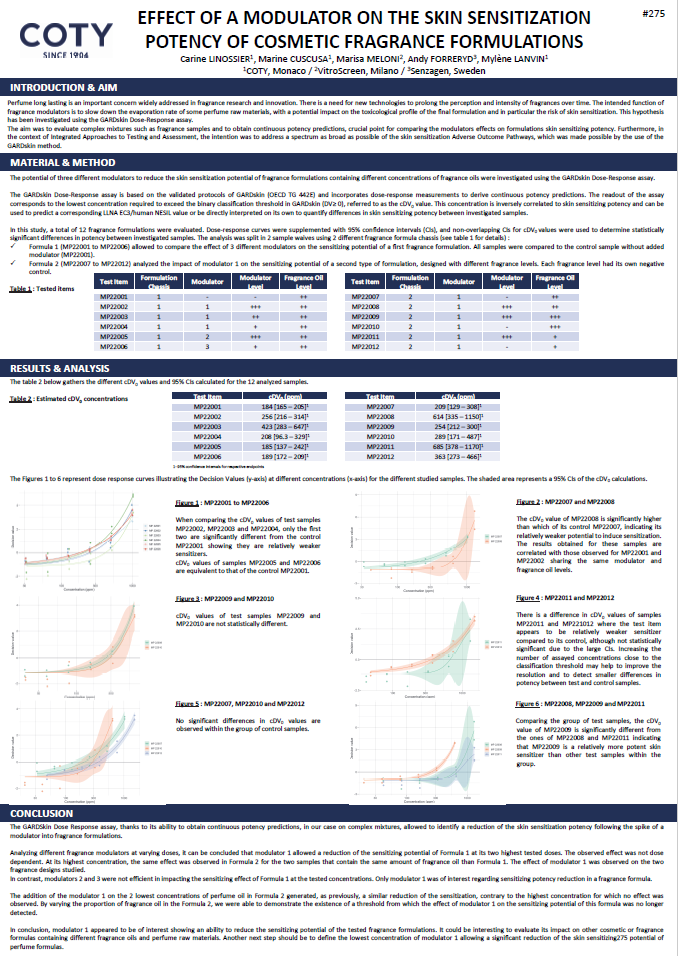
EFFECT OF A MODULATOR ON THE SKIN SENSITIZATION POTENCY OF COSMETIC FRAGRANCE FORMULATIONS

Presented at 2022 ESTIV

Download a copy in PDF


Conclusion

The GARDskin Dose-Response assay, thanks to its ability to obtain continuous potency predictions, in our case on complex mixtures, allowed to identify a reduction of the skin sensitization potency following the spike of a modulator into fragrance formulations.

Analyzing different fragrance modulators at varying doses, it can be concluded that modulator 1 allowed a reduction of the sensitizing potential of Formula 1 at its two highest tested doses. The observed effect was not dose dependent. At its highest concentration, the same effect was observed in Formula 2 for the two samples that contain the same amount of fragrance oil than Formula 1. The effect of modulator 1 was observed on the two fragrance designs studied. In contrast, modulators 2 and 3 were not efficient in impacting the sensitizing effect of Formula 1 at the tested concentrations. Only modulator 1 was of interest regarding sensitizing potency reduction in a fragrance formula.

The addition of the modulator 1 on the 2 lowest concentrations of perfume oil in Formula 2 generated, as previously, a similar reduction of the sensitization, contrary to the highest concentration for which no effect was observed. By varying the proportion of fragrance oil in the Formula 2, we were able to demonstrate the existence of a threshold from which the effect of modulator 1 on the sensitizing potential of this formula was no longer detected.

In conclusion, modulator 1 appeared to be of interest showing an ability to reduce the sensitizing potential of the tested fragrance formulations. It could be interesting to evaluate its impact on other cosmetic or fragrance formulas containing different fragrance oils and perfume raw materials. Another next step should be to define the lowest concentration of modulator 1 allowing a significant reduction of the skin sensitizing potential of perfume formulas.

Abstract

Perfume long lasting is an important concern that is widely addressed in fragrance research and innovation. To this end, there is a need for new technologies to prolong the perception and intensity of fragrances over time. The intended function of fragrance modulators is to slow down the evaporation rate of perfume raw materials. But while they may improve fragrance properties, they may also impact the toxicological profile of the final formulation. This work evaluated the impact of a modulator on the skin sensitizing potency of a fragrance formulation using the GARDskin Dose-response assay.

GARDskin Dose-Response is a modification of the validated protocols of GARDskin (OECD TGP 4.106) that incorporates dose-response analysis. The readout is a cDV0 value, describing the lowest concentration required to generate a positive classification. This value correlates with potency and can be used to rank test items by their relative sensitizing potency. The assay was used due to its capacity to evaluate complex mixtures and because it delivers continuous potency predictions, which was crucial for effectively comparing the modulator’s effect on the formulation’s skin sensitizing potency.

This study examined the effect on a formulation’s skin sensitizing potency when a modulator was added by assaying two otherwise identical formulations. Testing was performed using GARDskin Dose-Response, and the derived cDV0 values were compared using 95% confidence intervals (CI).

Fragrance formulations gave rise to monotonically increasing dose-response curves and cDV0 values were estimated. The cDV0 value for the fragrance formulation containing the modulator was significantly higher (458ppm, 95%CI: 332-626) compared with the cDV0 value for the naïve fragrance formulation (268ppm, 95%CI: 248-292), indicating a potential for the modulator to reduce the sensitization potency of the evaluated fragrance formulation.

Based on the encouraging data reported in this study, the modulator appears to reduce the sensitization potency of the evaluated fragrance mixture.