Joint poster with ExxonMobil: Case study on UVCBs and Formulated Lubricant Products

Assessing the Utility of the Genomic Allergen Rapid Detection (GARDskin) Assay to Detect Dermal Sensitization Potential in UVCBs and Formulated Lubricant Products


Presented at SOT 2023

Download a copy

Summary

  • GARD®skin is considered to provide useful information in an overall weight of evidence assessment for difficult to test materials (mixtures, UVCBs) with challenging physical chemical properties.
  • The accuracy for prediction of skin sensitization hazard ranged from 66% for formulated lubricants/greases to 100% for synthetic base oils compared to expected outcomes based on reference data.

Abstract

Advances in new approach methods and their combinations into defined approaches can provide clarity and confidence in concluding on skin sensitization potential. However, challenges remain in utilizing these approaches for difficult to test materials such as those with challenging physical chemical properties (low water solubility, hydrophobic substances) or complex compositions like Unknown or Variable Composition Complex reaction products or Biological Materials (UVCBs) and formulated mixtures. The previously developed available non-animal test methods for skin sensitization based on key-events of the adverse outcome pathway (AOP) have clearly defined requirements for test material properties that impact feasibility or confound reliance on negative results particularly for difficult to test materials and impedes the application of defined approaches to conclude on skin sensitization hazard. A set of difficult to test materials were evaluated in the recently validated GARDskin assay since it offered advantages such as a broader applicability domain, availability of additional validated test solvents for poorly soluble materials and provides mechanistically relevant information on key events from across the skin sensitization AOP. The aim of the study was to evaluate the accuracy of the GARDskin assay for a set of synthetic base oils (UVCBs), lubricant additives (UVCBs/poorly soluble substances) and fully formulated lubricants/greases (mixtures) as well as to provide additional information to assist in a weight of evidence determination given that several of the test materials had borderline or conflicting data from other key events within the skin sensitization AOP. All test items were adequately solubilized in one of the following solvents, Ethanol (0.1% final), DMSO (0.25% or 0.1% final), or Xylenes (0.1% final). SenzaCells were incubated in triplicate under standard conditions with the test items at a max concentration of 500uM for those with a known molecular weight or 100 ppm (w/v) for those without a known molecular weight. Following cell stimulations, RNA was isolated and endpoint measurements were performed using the GARDskin genomic profile signature. Based on the results of this study, the accuracy for prediction of skin sensitization hazard was 100% for synthetic base oils (n=4), 83% for lubricant additives (n=6), and 66% for formulated lubricants/greases (n=6) compared to expected outcomes based on available reference data. In some cases, the available reference data was borderline or considered to have low confidence due to confounding factors such as irritation, and nonmonotonic dose responses impacting the accuracy determination when compared one to one with either animal or human data. However, the GARDskin assay is considered to provide useful insight into the overall weight of evidence for difficult to test materials with conflicting datasets as it provides an additional profile of bioactivity across the skin sensitization adverse outcome pathway. 


SenzaGen’s Newsletter Dec 2022

Click image to view the newsletter in browser.


SenzaGen has acquired ToxHub to strengthen toxicology offering


​

ToxHub has joined the SenzaGen Group as independent regulatory toxicology experts. Our customer-centric in vitro testing services and cutting-edge GARD® technologyies have been complemented by ToxHub’s tailored toxicology advisory services. Based in Rome, Italy, ToxHub specializes in toxicological risk assessment and regulatory strategy consulting, with specific expertise in medical devices and pharmacology. ​

​About ToxHub​

Founded by toxicologists with 25-years of experience in the pharmaceutical industry, ToxHub provides tailored and cost-effective toxicology advisory services to customers across industries. ToxHub’s risk assessment and regulatory compliance services include the following key areas:​

  • Hazard identification, hazard characterization including dose-response analysis to define a Point of Departure, exposure evaluation and risk characterization for pharmaceutical and non-pharmaceutical ingredients, chemicals, contaminants and impurities. ​
  • Regulatory strategy advisory and compilation of regulatory documentation (IB, IMPDs, INDs, etc).​
  • Regulatory support when interacting with authorities, including responses to deficiency letters. ​
  • Biological evaluation of medical devices (MDR).​

​https://toxhub-consulting.com​

​

​

​

​

​


Joint poster with Coty: Case study on Cosmetic Fragrance Formulations

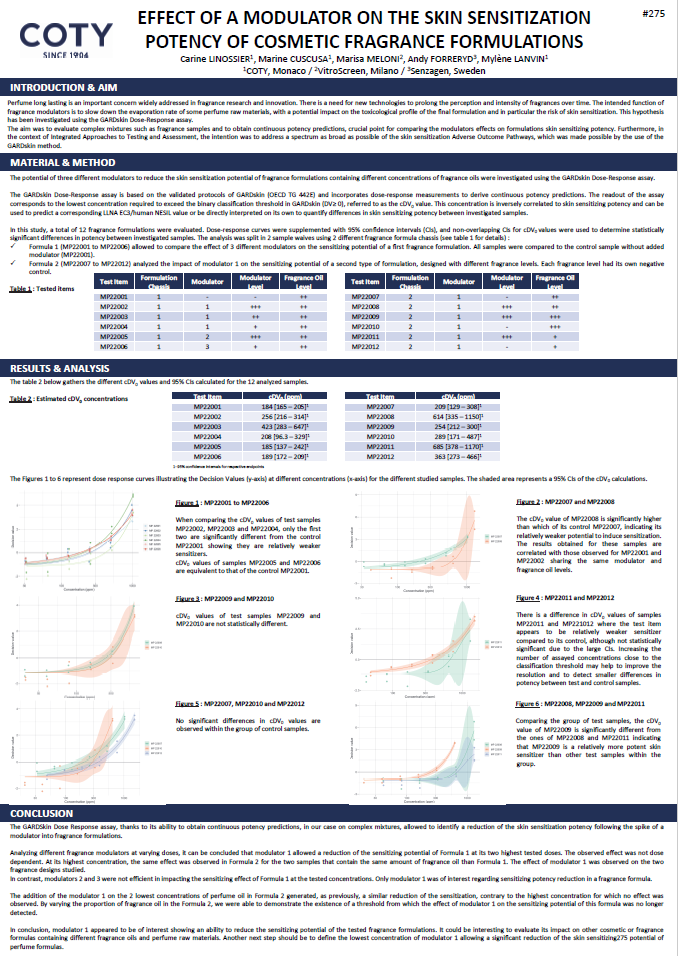
EFFECT OF A MODULATOR ON THE SKIN SENSITIZATION POTENCY OF COSMETIC FRAGRANCE FORMULATIONS

Presented at 2022 ESTIV

Download a copy in PDF


Conclusion

The GARDskin Dose-Response assay, thanks to its ability to obtain continuous potency predictions, in our case on complex mixtures, allowed to identify a reduction of the skin sensitization potency following the spike of a modulator into fragrance formulations.

Analyzing different fragrance modulators at varying doses, it can be concluded that modulator 1 allowed a reduction of the sensitizing potential of Formula 1 at its two highest tested doses. The observed effect was not dose dependent. At its highest concentration, the same effect was observed in Formula 2 for the two samples that contain the same amount of fragrance oil than Formula 1. The effect of modulator 1 was observed on the two fragrance designs studied. In contrast, modulators 2 and 3 were not efficient in impacting the sensitizing effect of Formula 1 at the tested concentrations. Only modulator 1 was of interest regarding sensitizing potency reduction in a fragrance formula.

The addition of the modulator 1 on the 2 lowest concentrations of perfume oil in Formula 2 generated, as previously, a similar reduction of the sensitization, contrary to the highest concentration for which no effect was observed. By varying the proportion of fragrance oil in the Formula 2, we were able to demonstrate the existence of a threshold from which the effect of modulator 1 on the sensitizing potential of this formula was no longer detected.

In conclusion, modulator 1 appeared to be of interest showing an ability to reduce the sensitizing potential of the tested fragrance formulations. It could be interesting to evaluate its impact on other cosmetic or fragrance formulas containing different fragrance oils and perfume raw materials. Another next step should be to define the lowest concentration of modulator 1 allowing a significant reduction of the skin sensitizing potential of perfume formulas.

​

Abstract

Perfume long lasting is an important concern that is widely addressed in fragrance research and innovation. To this end, there is a need for new technologies to prolong the perception and intensity of fragrances over time. The intended function of fragrance modulators is to slow down the evaporation rate of perfume raw materials. But while they may improve fragrance properties, they may also impact the toxicological profile of the final formulation. This work evaluated the impact of a modulator on the skin sensitizing potency of a fragrance formulation using the GARDskin Dose-response assay.

GARDskin Dose-Response is a modification of the validated protocols of GARDskin (OECD TGP 4.106) that incorporates dose-response analysis. The readout is a cDV0 value, describing the lowest concentration required to generate a positive classification. This value correlates with potency and can be used to rank test items by their relative sensitizing potency. The assay was used due to its capacity to evaluate complex mixtures and because it delivers continuous potency predictions, which was crucial for effectively comparing the modulator’s effect on the formulation’s skin sensitizing potency.

This study examined the effect on a formulation’s skin sensitizing potency when a modulator was added by assaying two otherwise identical formulations. Testing was performed using GARDskin Dose-Response, and the derived cDV0 values were compared using 95% confidence intervals (CI).

Fragrance formulations gave rise to monotonically increasing dose-response curves and cDV0 values were estimated. The cDV0 value for the fragrance formulation containing the modulator was significantly higher (458ppm, 95%CI: 332-626) compared with the cDV0 value for the naïve fragrance formulation (268ppm, 95%CI: 248-292), indicating a potential for the modulator to reduce the sensitization potency of the evaluated fragrance formulation.

Based on the encouraging data reported in this study, the modulator appears to reduce the sensitization potency of the evaluated fragrance mixture.

Joint poster with DSM: Case study on process-related impurities in polymeric materials

In vitro assessment of skin sensitizing potential of process-related impurities in polymeric materials during product development.

Presented at 2022 ESTIV


Abstract

Andy Forreryd1, Stefan Kaiser2, Roman Goy2, Florian Glaus2, Ulrika Mattson1, Robin Gradin1, Henrik Johansson1

1 SenzaGen AB, 22381 Lund, Sweden

2 DSM Nutritional Products Ltd, 4303 Kaiseraugst, Switzerland

Skin sensitization testing represents a key toxicological endpoint during safety evaluation of ingredients intended for consumer products with topical exposure, both in a regulatory context and during product development, to early understand the toxicological profile of the end-product and potential impurities.

The inclusion of New Approach Methods (NAMs) for skin sensitization testing into OECD TGs have resulted in a broader acceptance of such methods as replacements to animal models. However, these methods are not universally applicable, and compounds with certain properties, such as lipophilicity, or of complex composition, are frequently considered outside the applicability domain.

GARDskin is a genomic-based next-generation in vitro assay for assessment of skin sensitizers progressing towards regulatory acceptance. The assay is highly sensitive, is compatible with a variety of solvents and has a demonstrated applicability for testing of lipophilic materials.

The aim of this study was to evaluate the skin sensitization potential of a lipophilic polymeric material (Mw > 2000g/mol) containing approximately 2% impurities, during product development. The polymeric material was initially flagged as a skin sensitizer. A preparative procedure was applied to purify the polymer from impurities, while generating enriched by-product fractions (oligomeric fraction, Mw: 500-1000 g/mol and small molecule fraction, Mw: <500 g/mol). The fractions were evaluated in GARDskin, using acetone or DMSO as solvents, and classified as skin sensitizers (by-products) and non-sensitizers (purified polymers, n=2), respectively, indicating that the impurities were responsible for the positive classification of the initial non-purified polymeric material.

In conclusion, the GARDskin protocol enabled for testing of the lipophilic materials, using a selection of solvents to increase solubility. Results from this study informed that actions to reduce concentration of impurities may be a useful strategy to prevent skin sensitization properties of the final end-product, highlighting the importance of skin sensitization testing during the production development.

SenzaGen’s services are now available online through the Science Exchange Marketplace!

We are proud to announce that SenzaGen’s services are now available online through the Science Exchange Marketplace!

The Science Exchange Marketplace is an all-in-one platform to source, order, manage, and pay for R&D services.


Visit Science Exchange Marketplace

The GARDskin assay: Investigation of the applicability domain for metals

Joint publication with Johnson Matthey

ALTEX – Alternatives to animal experimentation, published Nov 03, 2022, accepted manuscript

DOI: https://doi.org/10.14573/altex.2203021

Forreryd, A., Gradin, R., Larne, O., Rajapakse, N., Deag, E. and Johansson, H.


Abstract

New approach methods (NAMs) for hazard identification of skin sensitizing chemicals have been adopted as test guidelines by the OECD during the last decade as alternatives to animal models. These models align to individual key events (KE) in the adverse outcome pathway (AOP) for skin sensitization for which the molecular initiating event (MIE) is covalent binding to proteins. As it currently stands, the AOP does not include mechanistic events of sensitization by metals, and limited information is available on whether NAMs accurately the predict sensitization potential of such molecules, which have been proposed to act via alternative mechanisms to organic chemicals.

Methods for assessing the sensitization potential of metals would comprise valuable tools to support risk management within e.g., occupational settings during production of new metal salts or within the medical device industry to evaluate leachables from metal alloys.

This paper describes a systematic evaluation of the applicability domain of the GARD™skin assay for assessment of metals. Hazard classifications were supplemented with an extended analysis of gene expression profiles induced by metal sensitizers to compare the induction of toxicity pathways between metals and organic sensitizers. Based on the results of this study, the accuracy, sensitivity, and specificity of GARD™skin for prediction of skin sensitizing hazard were 92% (12/13), 100% (7/7) and 83% (5/6), respectively.

Thus, the performance of GARD™skin for assessment of metals was found to be similar to what is observed on conventional organic substances, providing support for inclusion of metals within the applicability domain of the test method.

Keywords

skin sensitization, metals, regulatory testing, medical devices

Full article on line with open access

Next Generation Risk Assessment (NGRA) using NAMs for skin sensitization: Reproducibility and precision of the GARDskin Dose-Response assay for PoD determination of fragrance chemicals.

Presented at ASCCT 2022

Next Generation Risk Assessment (NGRA) using NAMs for skin sensitization: Reproducibility and precision of the GARDskin Dose-Response assay for PoD determination of fragrance chemicals.

Andy Forreryd1, Shashi Donthamsetty2, Paul Sterchele2, Xiao Huang2, Gregory Ladics2, Mihwa Na3, Isabelle Lee3, Anne Marie Api3, Robin Gradin1, Henrik Johansson1
1SenzaGen, Lund, Sweden , 2International Flavors & Fragrances, Hazlet, NJ, USA, 3Research Institute for Fragrance Materials. Woodcliff lake, NJ, USA

Download a copy


Conclusion

  • GARD®skin Dose-Response can be used for continous predictions of skin sensitizing potency.
  • The continous readout from the assay is reproducible and the assay predicts LLNA EC3 and human NESIL values with high correlation to reference benchmark data.
  • The assay provides a nice tool for the fragrance industry to predict the NESIL value which can be used for conducting the quantitative risk assessment for generating the IFRA standard.

Abstract

New Approach Methods (NAMs) for assessment of skin sensitizers have been adopted as Test Guidelines (TGs) by OECD. When combined into Integrated Approaches to Testing and Assessment (IATA) or defined approaches (DA), they provide data supporting hazard classifications and GHS potency subcategorization. However, more granular potency information, preferably on a continuous scale, is needed to derive a point-of-departure (PoD) for Next Generation Risk Assessment (NGRA).

GARDskin was recently adopted into OECD TG 442E to support discrimination of skin sensitizers and non-sensitizers. Continous potency predictions are derived using a modified protocol that incorporates dose-response measurements. Linear regression models have further been developed to predict LLNA EC3 and human NOEL values. The aim of the following study, which represents a cross-sector collaboration was to evaluate precision and reproducibility of the potency predictions from GARDskin Dose-Response in blinded studies.

Preliminary results from estimate of precision (n=36 materials) indicated that GARDskin Dose-Response predicted LLNA EC3/ human NOEL values with median fold-misprediction factors < 3.0 and < 2.0, respectively. Interestingly, LLNA predicted human NOEL with a fold-change > 2 in the same dataset. For reproducibility assessment, test materials (n=11) were evaluated in separate experiments (n=3), which generated highly reproducible results, with an average median range of fold-changes between replicates of 2.5.

Results from this study demonstrate that continous potency predictions from GARDskin Dose-Response are reproducible. Together with performance data, this represents a major step towards establishment of the assay as a relevant source of information to derive a PoD for NGRA, avoiding generation of new animal data.


The use of the GARD®skin Dose-Response assay to assess skin sensitizing potency in developing novel fragrance ingredients

Presented at ASCCT 2022

The use of the GARD®skin Dose-Response assay to assess skin sensitizing potency in developing novel fragrance ingredients

Tim Lindberg1, Christopher Choi2, Ulrika Mattson1 and Satoshi Sasaki3
1SenzaGen, Lund, Sweden , 2Takasago International Corp, Rockleigh NJ, USA ,3Takasago International Corp, Hiratsuka city, Kanagawa, Japan

Download a copy


Conclusion

The present study aimed at investigating the skin sensitizing potency of two novel fragrances, Fragrance 1 and 2, using three NAMs, the kDPRA, KeratinoSens and GARD®skin Dose-Response assays.

To move away from traditional safety testing, which includes animal studies, there is a paradigm shift towards the use of multiple NAMs in a weight-of-evidence approach when risk assessment of novel fragrance ingredients are conducted. However, the lack of established potency assays puts the alternative methods at a disadvantage as compared to the in vivo counterparts.

  • Fragrance 1 showed similar results across the three NAMs, with the GARD®skin Dose-Response assay predicting the cDV0–value to 18.4 µM, which in turn was used to predict a NESIL-value of 659 µg/cm2.
  • For Fragrance 2, equivocal results were seen, where the kDPRA assay predicting the ingredient not to be a category 1A skin sensitizer while KeratinoSens predicted it as a non-skin sensitizer. GARD®skin Dose-Response predicted the cDV0–value to 296 µM, which was used to predict a NESIL-value of 16600 µg/cm2. Combining the results from all three NAM assays, a confirmatory HRIPT testing concentration was determined for both ingredients, 562.5 µg/cm2 and 15000 µg/cm2 for Fragrance 1 and Fragrance 2, respectively.

In conclusion the data presented here show how the use of the GARD®skin Dose-Response assay in combination with other NAMs can be used as a replacement of animal studies for quantitative risk assessment of novel fragrance materials.

Abstract

Skin sensitization is one of the required endpoints for the development and registration of novel fragrance ingredients. Traditionally, testing has been performed using a combination of in vitro and in vivo assays, but recent developments has shifted the paradigm towards the use of New Approach Methodologies (NAMs), without the need for in vivo methods. However, none of the proposed NAMs are currently validated for continuous potency predictions, which is required for quantitative risk assessments of novel fragrance ingredients.

The GARD®skin assay (OECD TG 442E) is a genomics-based assay for hazard identification of sensitizers. To meet the need for quantitative potency information, GARD®skin Dose-Response has been developed based on the validated protocols of GARD®skin and generates a dose-response curve to identify the lowest concentration of a test compound required to elicit a positive classification (cDV0 value). These values correlate significantly to LLNA EC3 and human NESIL values.

The aim of this study was to investigate the sensitizing potency of two novel fragrance ingredients and to identify predicted non-sensitizing levels. Testing was performed in GARD®skin Dose-Response, with predicted EC3 and NESIL values of 1.93% and 27.8%, and 659µg/cm2 and 16600µg/cm2, for fragrance ingredients 1 and 2, respectively. These results in combination with data from kDPRA, KeratinoSens and in silico read- across, established the concentrations for confirmatory HRIPT testing (562.5µg/cm2 and 15000µg/cm2).

In conclusion, this study demonstrates how GARD®skin Dose-Response combined with other NAMs can be used for risk assessments and to establish a concentration for confirmatory HRIPT testing of novel fragrance ingredients.


SenzaGen’s Newsletter Oct 2022

Click image to view the newsletter in browser.