Joint article: Skin sensitization assessment for wearable devices
Advancing skin sensitization assessment for wearable devices
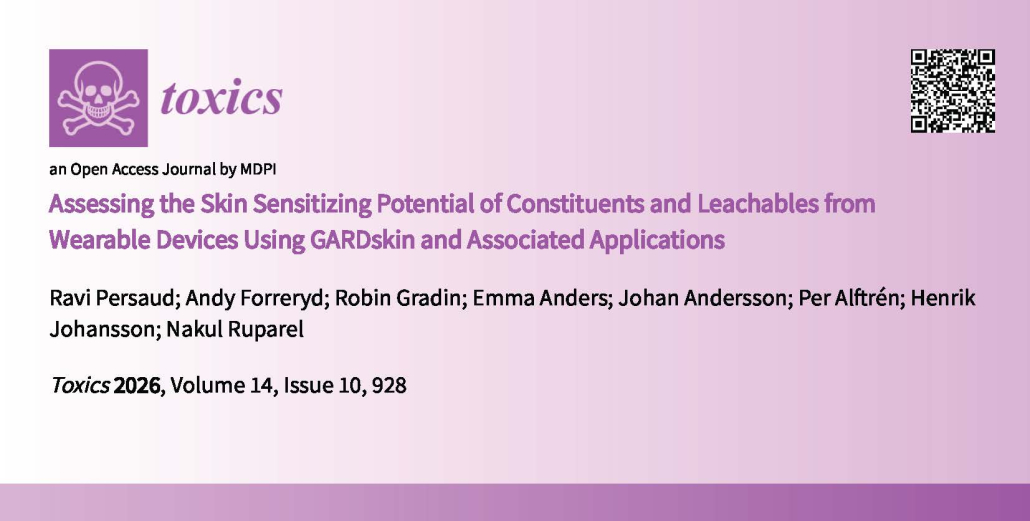
Assessing the Skin Sensitizing Potential of Constituents and Leachables from Wearable Devices Using GARDskin and Associated Applications
A new joint article has been published in Toxics, providing new peer-reviewed evidence demonstrating how the GARD® assays can support both quantitative risk assessment of wearable device constituents and hazard identification of leachables from finished products.
As wearable technologies continue to evolve, safety assessment presents unique challenges. Materials are often complex, multi-component, and intended for prolonged skin contact. This study highlights how New Approach Methodologies (NAMs) can generate the information needed for both product development and final product safety evaluations.
About the study
Part 1: Quantitative potency assessment of wearable device constituents
Six representative chemicals commonly used in wearable devices, including three acrylate monomers, two acrylamide monomers, and one reactive dye, were evaluated using GARD®skin Dose-Response to determine skin sensitization potency and derive Points of Departure (PoDs) for quantitative risk assessment.
Part 2: Hazard identification of leachables from finished products
In a proof-of-concept case study, GARD®skin Medical Device was used to evaluate extracts of MED-2000 prepared in both polar and non-polar extraction vehicles and spiked with the known sensitizer isobornyl acrylate (IBOA).
Key findings:
- All six wearable-relevant test chemicals were correctly identified as skin sensitizers, demonstrating strong performance within this applicability domain.
- GARD®skin Dose-Response generated quantitative potency estimates that were in line with available in vivo reference data and showed good concordance with potency values generated using defined approaches.
- GARD®skin Medical Device successfully detected IBOA in both polar and non-polar material extracts, supporting its applicability for testing leachables from solid materials and wearable devices.
Together, these findings demonstrate how GARD®-based testing strategies can support both safer-by-design product development and the biological safety assessment of final wearable devices, while reducing reliance on animal testing.
Authors
We extend our sincere gratitude to the outstanding team members who contributed to this scientific collaboration: Ravi Persaud1, Andy Forreryd2, Robin Gradin2, Emma Anders2, Johan Andersson2, Per Alftrén2, Henrik Johansson2 and, Nakul Ruparel1
1Apple, Inc., Cupertino, CA 95014, USA
2SenzaGen AB, SE-22481 Lund, Sweden
Keywords
wearable devices; skin sensitization; GARD; quantitative potency assessment
Abstract
Pre-clinical toxicological evaluation is an essential component of ensuring the safety and compatibility of wearable devices with biological systems. Along with the local endpoints of cytotoxicity and irritation, skin sensitization is a core toxicological endpoint. Testing wearable devices, which are often solid and composed of multiple components, presents new challenges for New Approach Methods. In the current proof-of-concept study, we propose a strategy for conducting risk assessment of the individual components and the leachables from wearable devices.
The GARDskin Dose-Response assay (OECD TGP 4.106) was used to predict the skin sensitization potency of three acrylate monomers, two acrylamide monomers, and one reactive dye. The GARDskin Medical Device (ISO 10993-10:2021, Annex C) was used to classify MED-2000 extracts spiked with isobornyl acrylate. All chemicals were classified as skin sensitizers. The quantitative potency predictions correlated well with available data from defined approaches and produced near-identical potency rankings.
Available human and animal reference data were too sparse and heterogenous to substantiate agreement in potency. Finally, the GARDskin Medical Device assay correctly classified the spiked extract as skin sensitizing. In conclusion, the GARDskin assay and associated applications are well adapted to address the testing requirements for wearable devices.