Joint publication with dōTERRA: Skin Sensitization potency assessment of Essential Oils
Advancing Skin Sensitization potency assessment for Essential Oils
Comparative analysis of a component-based prediction model, GARDskin Dose-Response assay, and the Local Lymph Node Assay (LLNA)
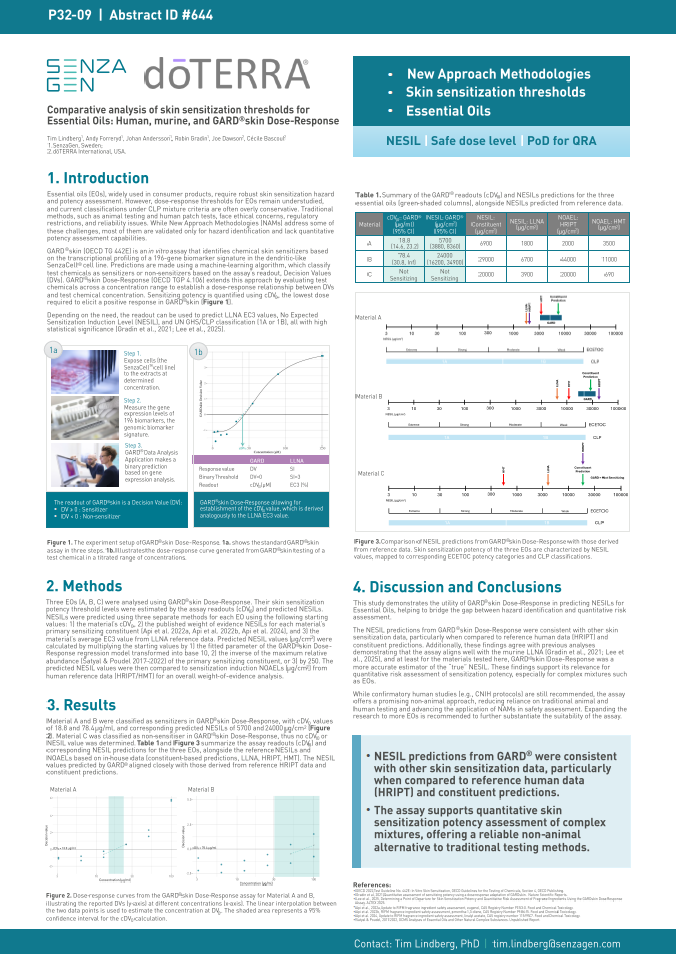
A new joint article by researchers from dōTERRA and SenzaGen has been published in Toxics, providing new peer-reviewed evidence supporting the applicability of GARD®skin Dose-Response for quantitative skin sensitization potency assessment of Essential Oils, a representative class of Natural Complex Substances (NCS).
The study addresses a key gap in non-animal skin sensitization testing: the quantitative potency assessment of complex mixtures. Results demonstrate strong overall concordance between GARD®skin Dose-Response and historical LLNA data, supporting the use of New Approach Methodologies (NAMs) to derive Points of Departure (PoDs) for quantitative skin sensitization risk assessment of complex mixtures.
About the study
Eight well-studied Essential Oils were evaluated using two non-animal approaches and benchmarked against historical LLNA data:
- GARD®skin Dose-Response: a genomics-based assay that extends the standard GARDskin OECD 442E methodology to enable quantitative skin sensitization potency assessment.
- Component-based Prediction (CP) model: a computational approach using constituent composition and known sensitization potency data to estimate mixture potency.
Key findings:
- Confirmed applicability of GARD®skin Dose-Response to Essential Oils for quantitative potency assessment.
- Strong overall concordance across all three approaches, indicating comparable potency estimates.
- GARD®-derived potency values generally aligned with historical LLNA data, supporting the method’s relevance for skin sensitization risk assessment.
Together, these findings provide further evidence supporting the use of non-animal approaches for quantitative skin sensitization risk assessment of complex mixtures.
Dawson, Joseph T., Tim Lindberg, Prabodh Satyal, Ambika Poudel, Dakota T. Carter, Sara A. Shah, and Cécile Bascoul. 2026.
"Comparative Analysis of Test Methods for Predicting Dermal Sensitization Potency in Essential Oils: A Component-Based Prediction Model, GARDskin Dose–Response Assay, and Local Lymph Node Assay"
Toxics 14, no. 9: 800. https://doi.org/10.3390/toxics14090800
Keywords
Skin sensitization; risk assessment; essential oils; mixtures; non-animal methods; new approach methodologies (NAMs); component-based prediction; GARDskin Dose-Response; local lymph node assay; comparative analysis
Abstract
The dose–response adaptation of the genomic allergen rapid detection for skin sensitizers (GARDskin DR) assay is a non-animal method for predicting sensitization potency. This proof-of-concept comparative analysis evaluates outputs from a component-based prediction model (CP), GARDskin DR, and historical local lymph node assays (LLNA), exploring the applicability of CP and GARDskin DR for evaluating the no-expected-sensitization induction level (NESIL) potencies of essential oils.
Eight well-studied essential oils were selected: cedarwood, cinnamon bark, clove bud, geranium, lavender, lemongrass, spearmint, and tea tree oils. Each underwent GARDskin DR as well as GC–MS, from which CP model outputs were derived. GARDskin DR, CP, and LLNA outputs were compared graphically and using preliminary descriptive statistics.
Results show overall statistical concordance in material ranking between methods (Kendall’s W = 0.857, p = 0.017). Bland–Altman log-transformed bias and limits of agreement show numerically higher NESILCP compared to corresponding NESILGARD and NESILLLNA, but sensitivity analysis shows this finding is statistically sensitive to geranium oil. Spearman’s rank correlations were significant between NESILCP vs. NESILGARD and NESILLLNA but not between NESILGARD vs. NESILLLNA despite numerical similarity.
Given the small sample, no statistical findings from this study are generalizable and should be interpreted descriptively. However, the NESIL results provide preliminary evidence supporting further evaluation of GARDskin DR and CP for dermal sensitization potency testing of essential oils.