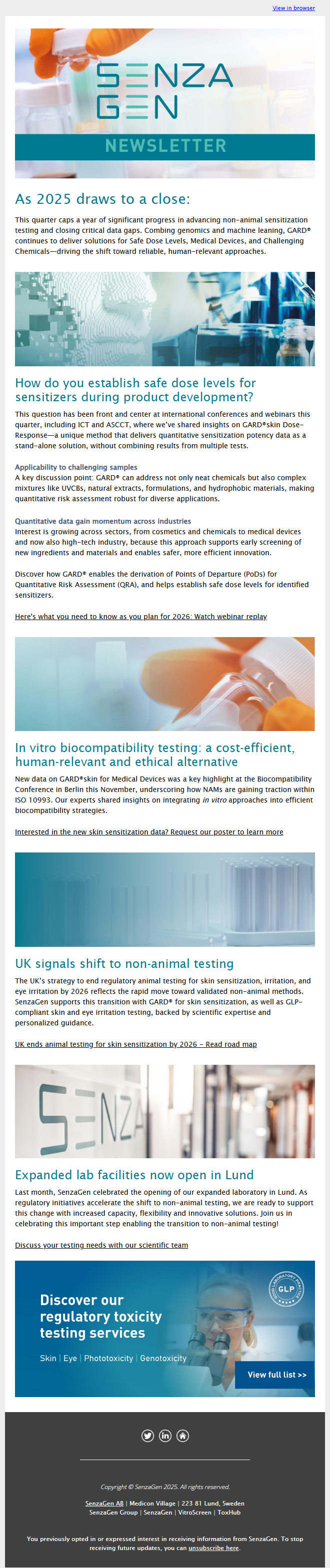
SenzaGen’s Newsletter Q4 2025

Click image to view the Newsletter in browser.


Text version:

SenzaGen Newsletter Q4, 2025

As 2025 draws to a close:

This quarter caps a year of significant progress in advancing non-animal sensitization testing and closing critical data gaps. Combing genomics and machine leaning, GARD® continues to deliver solutions for Safe Dose Levels, Medical Devices, and Challenging Chemicals—driving the shift toward reliable, human-relevant approaches.

2165 at a glance px webbbilder senzagen2

How do you establish safe dose levels for sensitizers during product development?

This question has been front and center at international conferences and webinars this quarter, including ICT and ASCCT, where we’ve shared insights on GARD®skin Dose-Response—a unique method that delivers quantitative sensitization potency data as a stand-alone solution, without combining results from multiple tests.

Applicability to challenging samples
A key discussion point: GARD® can address not only neat chemicals but also complex mixtures like UVCBs, natural extracts, formulations, and hydrophobic materials, making quantitative risk assessment robust for diverse applications.

Quantitative data gain momentum across industries 
Interest is growing across sectors, from cosmetics and chemicals to medical devices and now also high-tech industry, because this approach supports early screening of new ingredients and materials and enables safer, more efficient innovation.

Discover how GARD® enables the derivation of Points of Departure (PoDs) for Quantitative Risk Assessment (QRA), and helps establish safe dose levels for identified sensitizers.

Here’s what you need to know as you plan for 2026: Watch webinar replay

2129 Biocompatibility testing of medical devices

In vitro biocompatibility testing: a cost-efficient, human-relevant and ethical alternative

New data on GARD®skin for Medical Devices was a key highlight at the Biocompatibility Conference in Berlin this November, underscoring how NAMs are gaining traction within ISO 10993. Our experts shared insights on integrating in vitro approaches into efficient biocompatibility strategies.

Interested in the new skin sensitization data? Request our poster to learn more

2146 SenzaGen 2025 web sections

UK signals shift to non-animal testing

The UK’s strategy to end regulatory animal testing for skin sensitization, irritation, and eye irritation by 2026 reflects the rapid move toward validated non-animal methods. SenzaGen supports this transition with GARD® for skin sensitization, as well as GLP-compliant skin and eye irritation testing, backed by scientific expertise and personalized guidance.

UK ends animal testing for skin sensitization by 2026 – Read road map

2178 SenzaGen background

Expanded lab facilities now open in Lund

Last month, SenzaGen celebrated the opening of our expanded laboratory in Lund. As regulatory initiatives accelerate the shift to non-animal testing, we are ready to support this change with increased capacity, flexibility and innovative solutions. Join us in celebrating this important step enabling the transition to non-animal testing!

Discuss your testing needs with our scientific team

2171 LIME regulatory tox banner dec 2025 v3