Tag Archive for: safe dose levels

Joint poster with BIC: Case study on skin-binding dyes

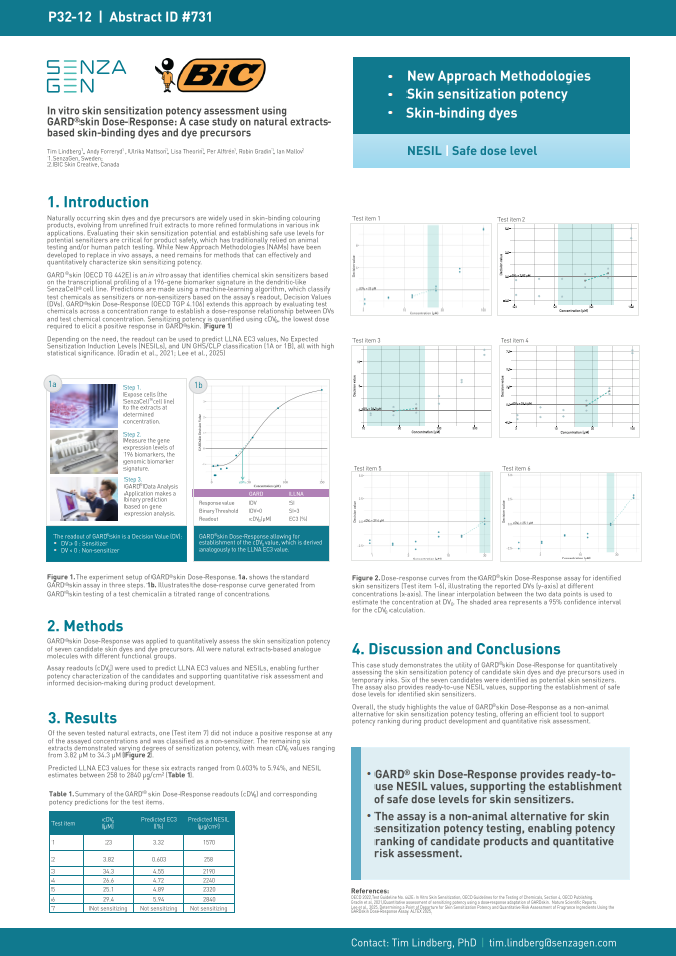
In vitro skin sensitization potency assessment using GARD®skin Dose-Response: A case study on natural extracts-based skin-binding dyes and dye precursors

Presented at 2025 Eurotox
Download a copy in PDF


Conclusion

  • GARD® skin Dose-Response provides ready-to-use NESIL values, supporting the establishment of safe dose levels for skin sensitizers.
  • The assay is a non-animal alternative for skin sensitization potency testing, enabling potency ranking of candidate products and quantitative risk assessment.

Abstract

Naturally occurring skin dyes and dye precursors are widely used in temporary tattoo products, evolving from unrefined fruit extracts to more refined formulations in various ink applications. Evaluating their skin sensitization potential and establishing safe use levels for potential sensitizers are critical for product safety, which has traditionally relied on animal testing and/or human patch testing. While New Approach Methodologies (NAMs) have been developed to replace in vivo assays, a need remains for methods that can effectively and quantitatively characterize skin sensitizing potency.

GARD®skin (OECD TG 442E) is an in vitro assay that identifies chemical skin sensitizers based on the transcriptional profiling of a 196-gene biomarker signature in the dendritic-like SenzaCell® cell line. Predictions are made using a machine-learning algorithm, which classify test chemicals as sensitizers or non-sensitizers based on the assay’s readout, Decision Values (DVs).  GARD®skin Dose-Response (OECD TGP 4.106) extends this approach by evaluating test chemicals across a concentration range to establish a dose-response relationship between DVs and test chemical concentration. Sensitizing potency is quantified using cDV0, the lowest dose required to elicit a positive response in GARD®skin. Depending on the need, the readout can be used to predict LLNA EC3 values, No Observable Effect Levels (NOELs)/No Expected Sensitization Induction Levels (NESILs), Human Potency (HP) Categories, and UN GHS/CLP classification (1A or 1B), all with high statistical significance.

This case study demonstrates the application of GARD®skin Dose-Response to quantitatively assess the skin sensitization potency of naturally occurring dye precursor that binds covalently to skin molecules, highlighting its use in temporary tattoo inks. Seven analogue molecules with different functional groups were investigated. While six exhibited varying degrees of sensitization potency with mean cDV0 values ranging from 3.82 µM to 34.3 µM, one functional group did not induce a positive response at any of the assayed concentrations and was subsequently classified as a non-sensitizer. Predicted LLNA EC3 values ranged from 0.60% to 4.72%, corresponding to Human Potency Categories HP2 to HP4, with NESIL estimates between 258 to 2840 µg/cm².

These findings demonstrate that GARD®skin Dose-Response provides ready-to-use NESIL values, enabling potency ranking of candidate ingredients and supporting the safety assessment of novel dyes and dye precursors. The study further highlights the assay’s value as a non-animal alternative for skin sensitization potency assessment in product development.

Joint poster with dōTERRA: Case study on Essential Oils

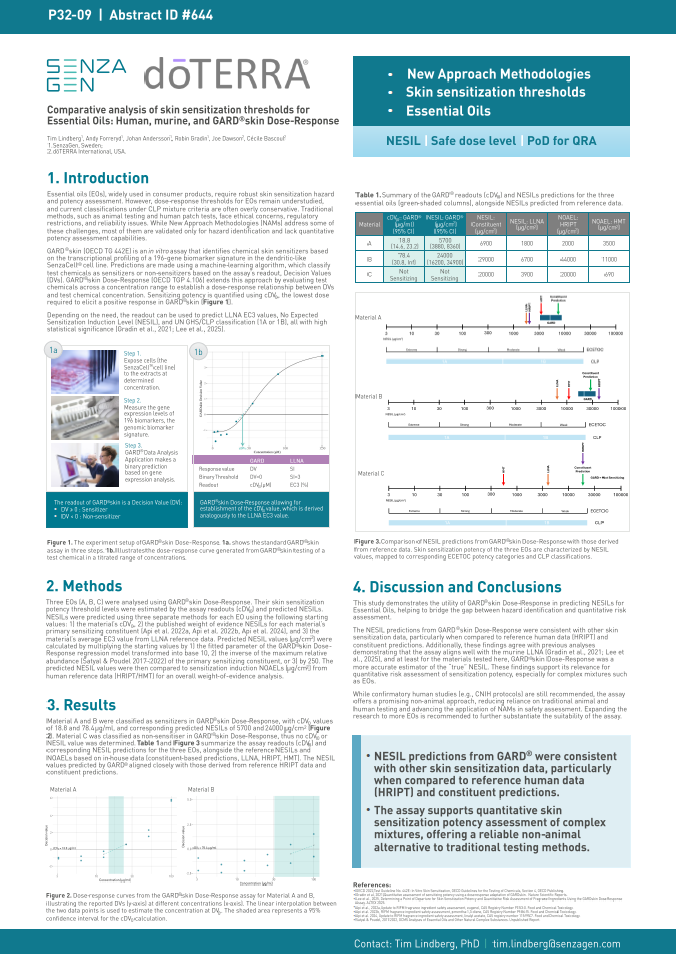
Comparative analysis of skin sensitization thresholds for Essential Oils: Human, murine, and GARD®skin Dose-Response

Presented at 2025 Eurotox

Download a copy in PDF


Conclusion

  • NESIL predictions from GARD® were consistent with other skin sensitization data, particularly when compared to reference human data (HRIPT) and constituent predictions.
  • The assay supports quantitative skin sensitization potency assessment of complex mixtures, offering a reliable non-animal alternative to traditional testing methods.

Abstract

Essential oils (EOs), widely used in consumer products, require robust skin sensitization hazard and potency assessment. However, dose-response thresholds for EOs remain understudied, and current classifications under CLP mixture criteria are often overly conservative. Traditional methods, such as animal testing and human patch tests, face ethical concerns, regulatory restrictions, and reliability issues. While New Approach Methodologies (NAMs) address some of these challenges, most of them are validated only for hazard identification and lack quantitative potency assessment capabilities.

GARD®skin (OECD TG 442E) is an in vitro assay that identifies chemical skin sensitizers based on the transcriptional profiling of a 196-gene biomarker signature in the dendritic-like SenzaCell® cell line. Predictions are made using a machine-learning algorithm, which classify test chemicals as sensitizers or non-sensitizers based on the assay’s readout, Decision Values (DVs). GARD®skin Dose-Response (OECD TGP 4.106) extends this approach by evaluating test chemicals across a concentration range to establish a dose-response relationship between DVs and test chemical concentration. Sensitizing potency is quantified using cDV0, the lowest dose required to elicit a positive response in GARD®skin. Depending on the need, the readout can be used to predict LLNA EC3 values, No Expected Sensitization Induction Level (NESIL), and UN GHS/CLP classification (1A or 1B), all with high statistical significance.

This study evaluates the utility of GARD®skin Dose-Response to predict NESILs for EOs, bridging the gap between hazard identification and quantitative risk assessment. Three EOs (A, B, C) were analysed using GARD®skin Dose-Response. Their skin sensitization potency threshold levels were estimated by the assay readouts (cDV0) and NESIL predictions. Results were compared to existing murine (LLNA EC3) and human (HRIPT/HMT) data through weight-of-evidence analysis.

For test item A, the predicted NESILs spanned were 5700 (GARD®), 6900 (constituent prediction), 1800 (LLNA), 2000 (HRIPT), and 3500 µg/cm² (HMT). Test item B showed NESILs of 24000 (GARD®), 29000 (constituent prediction), 6700 (LLNA), 44000 (HRIPT), and 11000 µg/cm² (HMT). Test item C was classified as a non-sensitizer by GARD®skin Dose-Response, with constituent prediction, LLNA, HRIPT, and HMT NESILs at 20000, 3900, 20000, and 690 µg/cm², respectively.

NESIL predictions from GARD®skin Dose-Response aligned with other skin sensitization test results, supporting its utility in quantitative sensitization potency assessment of complex natural extracts like EOs. While confirmatory human studies (e.g., CNIH protocols) are recommended, this assay reduces reliance on animal and human testing and advances the use of NAMs in safety assessment.