Joint poster with Coty: Case study on Cosmetic Fragrance Formulations
EFFECT OF A MODULATOR ON THE SKIN SENSITIZATION POTENCY OF COSMETIC FRAGRANCE FORMULATIONS
Presented at 2022 ESTIV
Conclusion
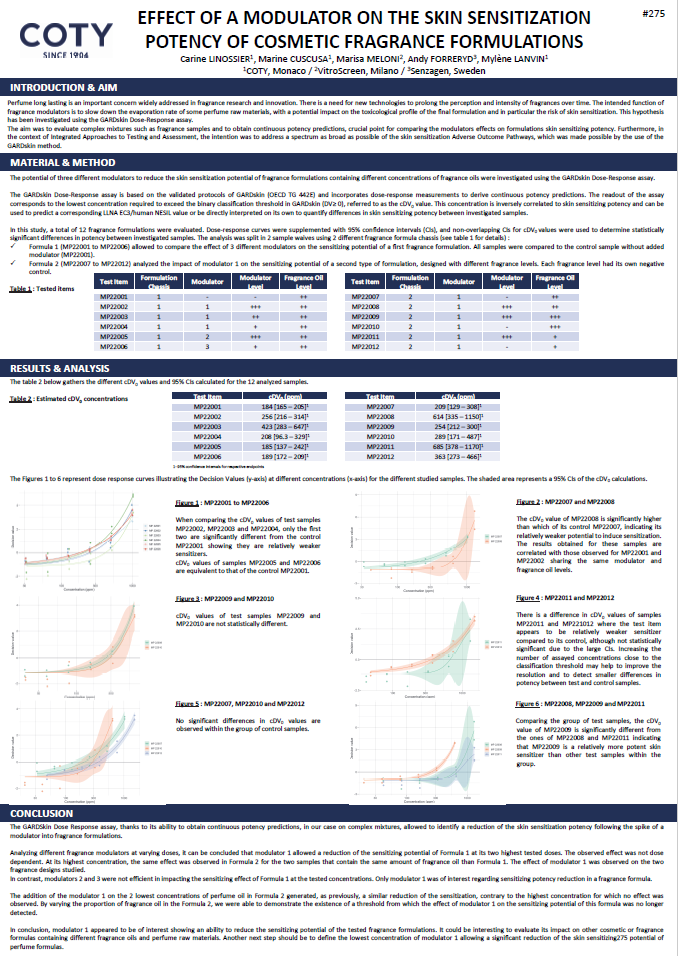
The GARDskin Dose-Response assay, thanks to its ability to obtain continuous potency predictions, in our case on complex mixtures, allowed to identify a reduction of the skin sensitization potency following the spike of a modulator into fragrance formulations.
Analyzing different fragrance modulators at varying doses, it can be concluded that modulator 1 allowed a reduction of the sensitizing potential of Formula 1 at its two highest tested doses. The observed effect was not dose dependent. At its highest concentration, the same effect was observed in Formula 2 for the two samples that contain the same amount of fragrance oil than Formula 1. The effect of modulator 1 was observed on the two fragrance designs studied. In contrast, modulators 2 and 3 were not efficient in impacting the sensitizing effect of Formula 1 at the tested concentrations. Only modulator 1 was of interest regarding sensitizing potency reduction in a fragrance formula.
The addition of the modulator 1 on the 2 lowest concentrations of perfume oil in Formula 2 generated, as previously, a similar reduction of the sensitization, contrary to the highest concentration for which no effect was observed. By varying the proportion of fragrance oil in the Formula 2, we were able to demonstrate the existence of a threshold from which the effect of modulator 1 on the sensitizing potential of this formula was no longer detected.
In conclusion, modulator 1 appeared to be of interest showing an ability to reduce the sensitizing potential of the tested fragrance formulations. It could be interesting to evaluate its impact on other cosmetic or fragrance formulas containing different fragrance oils and perfume raw materials. Another next step should be to define the lowest concentration of modulator 1 allowing a significant reduction of the skin sensitizing potential of perfume formulas.
Abstract
Perfume long lasting is an important concern that is widely addressed in fragrance research and innovation. To this end, there is a need for new technologies to prolong the perception and intensity of fragrances over time. The intended function of fragrance modulators is to slow down the evaporation rate of perfume raw materials. But while they may improve fragrance properties, they may also impact the toxicological profile of the final formulation. This work evaluated the impact of a modulator on the skin sensitizing potency of a fragrance formulation using the GARDskin Dose-response assay.
GARDskin Dose-Response is a modification of the validated protocols of GARDskin (OECD TGP 4.106) that incorporates dose-response analysis. The readout is a cDV0 value, describing the lowest concentration required to generate a positive classification. This value correlates with potency and can be used to rank test items by their relative sensitizing potency. The assay was used due to its capacity to evaluate complex mixtures and because it delivers continuous potency predictions, which was crucial for effectively comparing the modulator’s effect on the formulation’s skin sensitizing potency.
This study examined the effect on a formulation’s skin sensitizing potency when a modulator was added by assaying two otherwise identical formulations. Testing was performed using GARDskin Dose-Response, and the derived cDV0 values were compared using 95% confidence intervals (CI).
Fragrance formulations gave rise to monotonically increasing dose-response curves and cDV0 values were estimated. The cDV0 value for the fragrance formulation containing the modulator was significantly higher (458ppm, 95%CI: 332-626) compared with the cDV0 value for the naïve fragrance formulation (268ppm, 95%CI: 248-292), indicating a potential for the modulator to reduce the sensitization potency of the evaluated fragrance formulation.
Based on the encouraging data reported in this study, the modulator appears to reduce the sensitization potency of the evaluated fragrance mixture.